

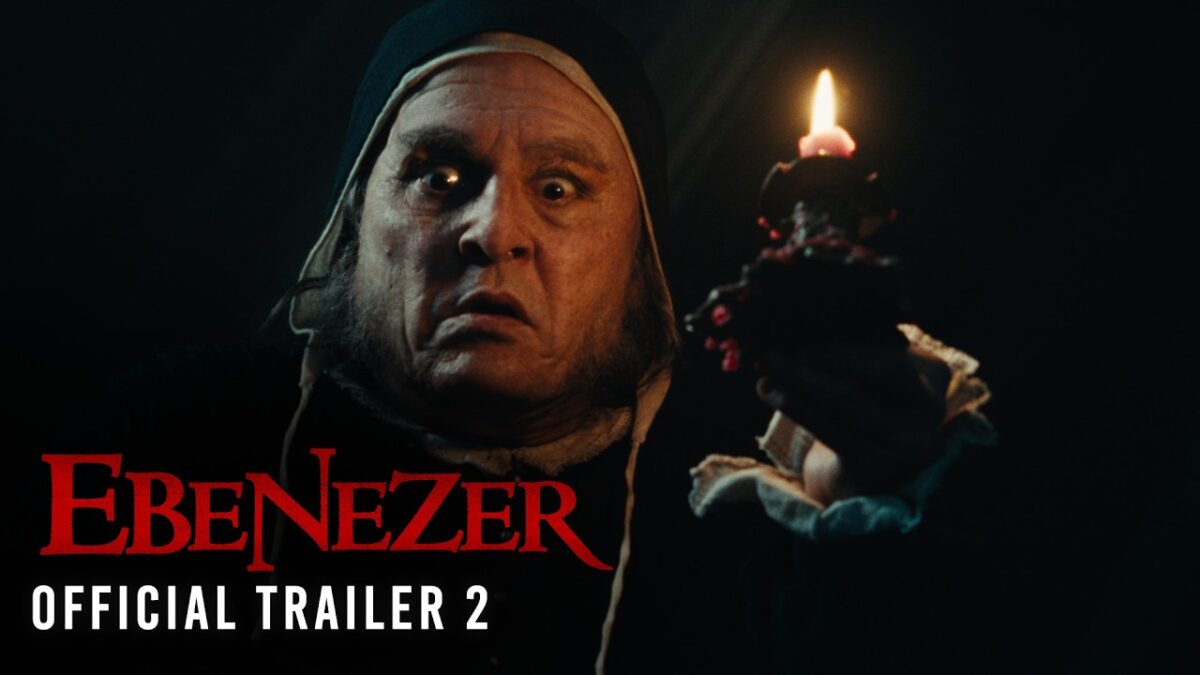
There’s an unmistakable irony in Johnny Depp making his return to major Hollywood studio filmmaking in a film about a contemptuous man forced to confront his past and offered a chance at redemption. Whatever one makes of Depp’s complicated public history, the parallel between the actor’s professional comeback and Ebenezer Scrooge’s journey toward a second chance is difficult to ignore. Yet Ti West’s lavish Gothic adaptation of Charles Dickens’ “A Christmas Carol,” “Ebenezer,” seems uninterested in that irony, or in finding much of anything fresh to say about the material.
Instead, the film feels oddly out of time, as though conceived in the late 1990s or early 2000s, abandoned on a studio shelf, and finally resurrected for reasons that remain unclear. Even Depp’s presence creates the sensation that we’ve somehow seen this movie before, perhaps as children: a half-forgotten Tim Burton production from the actor’s heyday that we vaguely remember but can’t quite place. A peculiar cinematic déjà vu hangs over the affair, and familiarity breeds not comfort but crushing boredom.
READ MORE: 88 Must-See Movies This Fall: ‘Dune: Part Three,’ ‘Digger,’ ‘Avengers: Doomsday,’ ‘The Adventures Of Cliff Booth’ & More
If there’s a contemporary anxiety to explore in Dickens’ endlessly recycled Christmas morality tale, a fresh perspective to introduce, or even a distinctive new flavor to inject into it, apparently no one told West. His “Ebenezer” is a painfully straight-faced adaptation, approaching the familiar narrative with such solemn reverence that it forgets to offer a compelling reason for existing. The same characters, revelations, and inevitable conclusion arrive wrapped in expensive Gothic production design and delivered at an interminable pace.

To be clear, this is not an incompetent production. It’s handsomely mounted, occasionally visually impressive, and certainly doesn’t look cheap. West’s Victorian London is appropriately dank, dour, dark, and cold, with shadowy interiors and oppressive architecture that evoke Dickens with considerable attention to detail. But recreating an aesthetic is not the same as doing something imaginative with it. Visually, the film resembles Burton’s late-1980s work, stripped of the mischievous whimsy, macabre humor, and playful invention that gave those films their personality. West borrows the familiar vocabulary of Gothic fantasy but little of its spirit, delivering an elaborate production that’s emotionally flat and dramatically inert.
That’s particularly disappointing from the filmmaker behind “X” and “Pearl,” whose previous work demonstrated a more distinctive relationship with horror and genre conventions. Here, West seems content to occupy a generously funded Gothic playground without bringing much of his own personality to it. The jump scares are pedestrian, offering little supernatural dread or invention. Even the ghostly visitations, which ought to invite imaginative filmmaking, feel like obligations to be checked off rather than sequences with their own sense of terror or wonder. Attempts at humor rarely land, and the unmemorable score does little to enliven the atmosphere.
As for Depp, one might be tempted to lay this dreary enterprise at his feet, but his performance is almost exactly what one would expect. It’s a greatest-hits compilation of familiar mannerisms and affectations, filtered into a miserable Scrooge so recognizable one can anticipate every gesture and inflection. The sneering, contempt, revolted apathy, and bottomless disgust for his fellow man: Depp captures a soused, misanthropic old boor whose bitterness has curdled into an entire worldview. There’s a recognizable truth to that portrait, but every scowl and drunken affectation feels secondhand, drawn as much from Depp’s own screen history as from earlier incarnations of Scrooge. Nothing is disastrous about the performance, but little is inspired, either. When he finally attempts to reveal some vulnerability, the results are mixed at best.
The supporting cast fares little better, with Ian McKellen as Jacob Marley, Andrea Riseborough as the Ghost of Christmas Past, and Tramell Tillman as the Ghost of Christmas Present largely reduced to familiar Dickensian caricatures. Daisy Ridley is saddled with a thankless role, while Sam Claflin fares somewhat better as Scrooge’s idealistic, good-hearted nephew. Surprisingly, Rupert Grint as Bob Cratchit emerges as the film’s most affecting presence. His modest, unforced humanity stands out amid the exaggerated personalities and theatrical wretchedness, making him one of the few characters whose circumstances inspire genuine sympathy.

Of course, Dickens’ tale is ultimately about a Christmas miracle: a thoroughly horrendous human being undergoes a change of heart and discovers some long-dormant capacity for empathy and care. We’re meant to be moved by the possibility of transformation, the comforting notion that even the most wretched might become better people. But Depp’s Scrooge is so relentlessly vile and contemptuous that it’s difficult to muster sympathy for him, let alone feel warmed by his awakening. Instead, one is left contemplating that this miserly old bastard would never have changed had he not been forcibly confronted with his grotesque shortcomings and the misery he’s inflicted on everyone around him.
If “Ebenezer” has anything contemporary to say—and if it does, it’s almost certainly unintentional—it might be as a parable for a recognizable strain of modern conservative thinking: a worldview in which compassion is treated as weakness, others’ suffering is dismissed, and sympathy emerges only when misfortune arrives at one’s own doorstep. This is an awakening born less of goodness than self-interest and fear. Three supernatural visitors essentially terrorize Scrooge into recognizing the consequences of remaining who he is. Dickens’ original already invites that provocative reading, but West seems uninterested in exploring it.

Instead, the film marches toward its conclusion, arriving at a character arc that somehow feels interminably drawn out, unearned, and absurdly rushed all at once. After an eternity of Scrooge’s misanthropy, his transformation arrives with the emotional sophistication of a man suddenly realizing, with considerable alarm, that, oh shit, he’s been behaving rather badly—and worse, there might be consequences he never bothered to consider. The shift from contempt to compassion feels mechanical rather than revelatory. By the supposedly uplifting resolution, Scrooge’s discovery of his humanity inspires considerably less enthusiasm than the prospect of the end credits.
There’s virtually no anticipation or suspense to sustain interest in a story whose every development has been committed to cultural memory. Knowing where a narrative is headed needn’t be a problem if there’s pleasure in how it unfolds. But West proceeds with such dutiful solemnity and painfully languid pacing that watching the film becomes an exercise in clock-watching. Dickens’ supernatural framework and moral complexity leave ample room for reinvention, but the filmmaker never manages to make the journey itself rewarding.
Support independent movie journalism. Sign up for The Playlist Newsletter for the latest film and TV news, reviews, interviews, and more—free.
For all its Gothic grandeur, “Ebenezer” is a punishingly dull, emotionally unrewarding slog whose resources only make its creative emptiness more conspicuous. Depp’s studio comeback through a story about confronting one’s failures and earning a second chance carries its own peculiar irony: while Scrooge is offered the opportunity to reinvent himself, neither the actor nor West brings much reinvention to this exhaustively familiar material. Dickens’ message about the transformative power of compassion has rarely felt so lifeless. By the end, the only Christmas miracle one is grateful for is that the whole interminable affair is finally over. [D−]

Rodrigo Perez
Publisher: Source link