
Summary
Collider’s Steven Weintraub talks with Pearl Jam lead guitarist Mike McCready for his graphic novel at SDCC 2026.
Farewell to Seasons is McCready’s historical fiction/fantasy graphic novel about Seattle’s early music scene.
He reflects on growing up in Seattle and discusses how he conceived the graphic novel, potential future adaptations, and Pearl Jam.
At this year’s San Diego Comic-Con, Rock & Roll Hall of Famer and Pearl Jam’s founding member and lead guitarist, Mike McCready, hit the con floor not only as a self-proclaimed fan of the convention’s collectibles, but to promote his new graphic novel, Farewell to Seasons. While there, McCready stopped by Collider’s studio to talk with Steven Weintraub about the inspiration behind the new novel and why this story demanded a new medium.
Written by McCready and Mark Sable, and illustrated by Sebastián Piriz, with Z2 Comics, Farewell to Seasons is the guitarist’s homage to the Seattle he grew up in in the late ‘80s into the early ‘90s. McCready describes it as “historical fiction of the Seattle music scene from 1985 to 1995, from the front row that I was in as I went through it.” It’s historical in its account of a darker Seattle before it became an epicenter of grunge music, but blends the darkness with fantasy elements he likens to Shakespeare’s A Midsummer Night’s Dream. The novel emphasizes the brutal cost of art for so many of the time, and asks, “Was it worth it?” You can watch the full conversation in the video above, with the transcript provided below, where McCready reflects on the era of music he came up in, the potential to turn Farewell to Seasons into a limited series or stage play, and shares his thoughts on a movie or series on Pearl Jam. He also talks about working with Cameron Crowe, unreleased music from Pearl Jam’s vault, and tons more.
Mike McCready Is a Big Spider-Man Fan
‘Spider-Man: Brand New Day’ just hit theaters.
Spider-Man in ‘Spider-Man: Brand New Day’Image via Sony Pictures / Marvel Studios
COLLIDER: This is a really cool interview for me. I’ve been a fan of Pearl Jam for a really long time, and it’s always thrilling when I get to talk to musicians. How are you doing, sir? MIKE MCCREADY: I’m doing well. I’ve just been coming to Comic-Con to promote my new graphic novel, Farewell to Seasons, and I love coming to these things. I’ve been going to them for years up in Seattle, but this is the first time at this giant one in San Diego. It’s insane. This is literally the biggest comic con in the world. Are you able to walk around anonymously in the crowd here, or do people see you, like, “Wait a minute, I know you?” MCCREADY: Some people do. Probably not as much as my ego wants. So I would probably say, yeah, I get recognized here. It’s also hard to recognize people because there are just so many people. MCCREADY: It’s really tight in here. Like, I’m busy looking at, you know, Batman and Captain Marvel, and people dressed up like that. That’s my favorite thing about it. Because we’re at Comic-Con, what do you actually collect? MCCREADY: Oh, me? I collect Spider-Man comics. Can I ask, do you buy them graded or do you just collect the comics? MCCREADY: I don’t buy them very expensive. I have number two for a lot of them, but I don’t buy them in mint condition because my wife would divorce me if I did that. But I collect that, and I just have a collecting thing — records, vinyl, all that kind of stuff, and guitars. I can’t imagine your guitar collection. MCCREADY: It’s pretty significant. It’s a lot. Do musicians trade guitars with each other? MCCREADY: Yeah. Yeah, yeah. I traded a guitar to Rick Nielsen from Cheap Trick, one of my models for one of his models. It’s fun to do that. When you do something like that, do you ask someone to sign it? MCCREADY: No. It’s strange because Rick Nielsen was a childhood hero of mine, and now we’re kind of friends. So, it would seem weird, like, “Hey, can you sign it for me?” But I’m not against an autograph. I’ve waited in line for things like that up in Seattle with my kids for Hayden Christensen and things like that. That’s great. I get things sometimes from friends who are in the limelight, and I don’t ask for signatures. Maybe I should. MCCREADY: It depends on the situation.
Mike McCready Reveals the Musician He Wishes He Could See in Concert
“I’ve always been influenced by him.”
Jimi Hendrix Experience Hendrix album cover.Image via MCA Recordings
What musician or artist would you have loved to have seen in concert? MCCREADY: Oh my gosh, it’d have to be Hendrix, since I’m from Seattle, and I love his playing, and I’ve always been influenced by him. Just to hear the power. I would have loved to see him at Monterey when he first came out and was doing “Killing Floor” by Howlin’ Wolf, Willie Dixon, and when he kind of stole the collective mind of America at that time. Of what I’ve seen from the footage of Monterey, I wish I was there in the front row. My favorite band is Queen. I love Queen… MCCREADY: I never saw them. I wish I did. Queen 2 is my favorite record. I love Pearl Jam, but what Freddie Mercury accomplished — he’s a genius beyond genius. MCCREADY: I agree. What I can tell you, though, is if you’re in Pearl Jam and you watch a Queen video before going on stage, it’ll fuck your whole show up — and that’s what we did. We watched Queen Rock Montreal, and we didn’t talk about it, but we were like, “Eh, our show wasn’t that good,” because we watched Queen before we went on. Don’t do that, kids. Don’t do that at home. It’s true. They did a great soundtrack with Flash Gordon. Have you guys ever been offered a movie or a show in terms of doing the entire soundtrack? MCCREADY: Personally, I’ve done a few things. I’ve done a Johnny Cash documentary called The Gift and an Elvis documentary called The Searcher. I’ve done some scoring in another movie called Fat Kid Rules the World; Matt Lillard was the director of that, and I played the leads in Almost Famous on that. So personally, I’ve done a few things myself. In terms of the whole band doing a soundtrack, I’m sure we’ve been offered things, but I’ve not heard that. I’ve always wondered why more bands don’t collaborate the way rappers collaborate, and this is all hypothetical, but like Pearl Jam with insert-other-band. There’s not a lot of crossover. MCCREADY: I’m not sure if that’s necessarily true. I think in terms of the Seattle music scene, if you look at it that way. Early on, we were all going to each other’s shows because it was a small scene back in the late ‘80s, early ‘90s. It’s a very small provincial town. The city did not support the music scene at all at that time, so we as kids, or as young band members, would go to each other’s shows. So, in that way we would collaborate together. We did the Temple of Dog thing, so there was that. That was kind of a collaboration. And I did a record called Mad Season with Layne Staley. So, I feel like we have done some of that, maybe not to the extent as the rap community and things like that. I think collaborating with people in any genre is fantastic because you just learn something different from different artists.
Mike McCready Shares His Thoughts on ‘Singles’
“I think I was pissed because I wasn’t in it.”
Bridget Fonda as Janet and Matt Dillon as Cliff look at each other in Singles (1992).Image via Warner Bros.
Can you watch the movie Singles now? What was your take on it when it came out, and what is it like looking at it now? MCCREADY: [Laughs] I think I was pissed because I wasn’t in it because they got Ed [Vedder] and Jeff [Ament] and Stone [Gossard], and I wasn’t asked. I was like, “But what about me?” Anyways, now I’m okay with it. I haven’t seen it since then. But Cameron Crowe, who’s a friend of mine, early on got me to play on Almost Famous after that. He’s always been good to me after, in other films, and I’ve been able to do music for. That movie, Singles, at the time was part of the craziness of what was going on in Seattle, whereas a year before, we’re all just playing clubs and hanging out. You know what I mean? Nobody expected Seattle to blow up in that way. We were just doing music to do music. There was never a, like, “If we do this and this and this, we’ll get a record contract, and then we’ll get on the road.” That wasn’t really an option. Sub Pop was kind of starting that, but Seattle was overlooked in the ‘80s until the ‘90s. Bands that would come to play would go to Portland and Vancouver, and they’d miss Seattle. So Seattle, we were all kind of pissed about that in a way. So it made us kind of “do it yourself,” I guess. So, when Singles came out, that was part of the, “Wow! This is this explosion that none of us expected to happen.” So we all were trying to ride that wave, I guess. The other thing about Singles is he was making that before the Seattle scene had taken off, so he was really ahead of the curve. Then, when it all started blowing up, you had the movie, which amplified it. It also had that killer soundtrack. MCCREADY: Great soundtrack. And Cameron has an incredible mind. He’s brilliant. He’s a genius. He was on the road with Led Zeppelin when he was 15 years old, so he’s been connected to the music scene since the ‘70s. And in terms of knowing what to film and knowing what to look for, he was in Seattle at the right time. He also made Seattle look better than it was, in a way. Again, it’s really weird watching it now. It captures a time that is so gone. MCCREADY: Exactly. Yes, because it’s pre-Amazon — I mean, Starbucks was around — it’s pre-Microsoft, or it’s just the beginnings of Microsoft. The city was so much different back then. It was a lot smaller. Boeing and logging was kind of going on up there in Seattle, and Seahawks and all those kind of things. Also, it still rained. MCCREADY: Yes. Exactly. It’s raining less now because of whatever. But yeah, it does capture a moment of what it was like. The Fabulous Baker Boys does that, too, if you’ve ever watched that movie. I haven’t watched that in a while. MCCREADY: Yeah. That shows you what Seattle kind of looked like, the darkness, which turns into the music.
Why Mike McCready Got Into the Graphic Novel Game
“How do I write a rock opera?”
Album Cover for Farewell to SeasonsImage via Pearl Jam
You’ve spent your career telling stories without words through the guitar. What was the story you needed to tell that finally required dialogue, characters, and an entire graphic novel world? MCCREADY: What happened was around the time of COVID, when we were all kind of locked down. I was just thinking about the friends that I’ve lost in this music scene and the kind of horrible cliché of all the singers that were lost, and I was thinking, “Was it worth it for these guys? Is art at any cost worth it?” That was the question I was kind of struggling with, so I wanted to put that into a context of, not a graphic novel yet, but a rock opera, and write music for that, and tell a story, like a historical fiction, but with fantasy elements to it. So, that’s what it originally was. I had talked to Cameron Crowe about, “How do I do this? How do I write a rock opera? What do you recommend?” And he gave me some great insights into things, like an 11th-hour song where the character has to make a decision that’s a fate. But at any rate, it took a left turn when I got in contact with Z2. They saw my script, and they understood it, and Josh [Bernstein] and Rantz [A. Hoseley] understood where I was coming from, and they wanted to do a graphic novel. I was like, “Sure, I’ll try that.” That wasn’t my initial intention to do, though. But to answer your question, I had to flesh out characters. I had to create its own world. I wanted to create a fantasy element in terms of the narrator, which is the Queen of the Seasons. She’s kind of the oracle of the story that tells the story of three characters: Jonathan Alexander, who’s our tragic tragedy; David Williams, who’s kind of me; and then Angela Sunrise, who’s a female character in there. So, it’s their trajectory from ‘85 to ‘95. As we look at the book/graphic novel, how does this finished version that’s sitting right here compare to what you thought it was going to be when you first started? MCCREADY: It’s turned the conception of it from black and white in my head to Technicolor in terms of what the characters look like, in terms of what Seattle looked like at that time in the ‘90s, in terms of the fantasy elements of it. Everything that was in my brain looks better in this, I have to say, just because I didn’t really know how to conceptualize it other than as a stage show. But as a graphic novel or a book, this has helped. When readers finish Farewell to Seasons, and hear the companion music, what do you hope they understand about that era and about you that they did not understand before? MCCREADY: I think that I just want people to have a human connection to the story. I would love people just to feel something. The difference of it is maybe there’s some humor that people didn’t really know that came out of the Seattle scene. There’s a lot of darkness, which isn’t a surprise. I’m looking at this from 20/20 vision, 30 years in the future, looking back at it, to have some perspective. If people who went through this scene and love the music from that time reflect on their life and where it’s gone in the last 30 years. Has it been worthwhile? Have you gained something from it? Does the music mean something to you still? Those kind of things.
Mike McCready Has Already Had “Conversations” About a ‘Farewell to Seasons’ Adaptation
McCready also responds to the idea of a Pearl Jam movie.
Paul McCready in ‘Pearl Jam; Let’s Play Two’Image via Abramorama
When you make something like this, now that it’s done and out, how much in your mind do you think about, “This could be a good stage play,” or “This could be a good limited series? This could be adapted to another medium?” MCCREADY: All of that. I would love it to turn into some sort of a stage play or a limited series on TV. If there’s that interest, I would follow that through to the end. I’ve had a few conversations about those things with some people, and that’s been enlightening. Nothing solid or firm yet, but I would love this to turn into something different. When you do a meeting, what is that initial conversation like? What kind of questions are you being asked, if you don’t mind sharing? MCCREADY: I would do a pitch and say, “Look, I’ve written historical fiction with fantasy elements called Farewell to Seasons. It’s basically, again, a historical historical fiction of the Seattle music scene from 1985 to 1995, from the front row that I was in as I went through it.” But it also has elements of spirits and kind of a Midsummer Night’s Dream feel to it, I hope. We have a spirit named Shade, which appears as a record company guy or drug dealer or someone that tries to lead our characters astray. Or there’s one called Spark, who is a seer of futures, and that character shows different futures for our characters, and all the while, guided by the Queen of the Seasons, who’s this kind of mythical oracle of the story, as we are going through a journey trying to make it in the music business. So, I kind of pitch it like that, and hopefully that made sense, and hear what they have to say. The story of Pearl Jam is pretty remarkable about how you guys started and ultimately where you’ve gone. You look at what happened with Michael Jackson at the box office, you look at music at the box office and on TV, your real story could be an amazing movie or TV show. It could be anything. Is that something that you’ve thought about, or is that something that doesn’t even enter the brain? MCCREADY: It’s funny, with Pearl Jam, we work at a different speed. It takes us a long time to do things, in terms of making a decision on whether we’re going to put a song in a movie, or whether we’re going to do a record, or whether we go on tour. There are a lot of moving parts that go on. We’ve got, like, five different guys that have different opinions on everything, and a manager, a whole crew, and all that stuff. So, we would have to have come to a consensus on what that is, in terms of, like, a democratic kind of consensus, of what this movie is if we were to do something like that, which I think would take fucking forever for us to do that. So, I’m jumping the line to start doing that stuff myself. I would love to do something like this in terms of a TV series or something that would examine the Seattle scene that you were talking about earlier, that was smaller back then. Downtown was dirty and grimy, and the sailors were fighting, and all this kind of stuff. Now, it’s not that anymore. And what it is now. At any rate, I would love to pursue that myself. The band, it’s a lot more convoluted to make things happen. I totally get it. You know that they’re making the four Beatles movies. I’m so curious about that and how that’s going to intersect with Sam Mendes and Greig Fraser shooting it. I’m so excited. MCCREADY: Yeah. How do you capture Liverpool in 1962? It’s also interesting because they’re making four movies, all from the different perspective of the members. MCCREADY: I love that. There are rumors that they’re all coming out on the same day, so you can choose the version, but I don’t know if that’s true anymore. It’s such an ambitious project. MCCREADY: You know what it is? It’s also your personality. It’s like, “I’m the Ringo guy. I want to watch the Ringo one,” or “I’m the Paul guy. I want to watch the Paul one.” It’s a good idea. I think because it’s the Beatles, you can pull something like this off, but, man, it is one of the most ambitious… It’s four movies. It’s amazing. MCCREADY: That’s pretty cool. That’s very ambitious. But you’re right, it’s the Beatles. They’re kind of the high watermark of all bands. Also, you knew the Michael Jackson movie was going to be a hit because of the music. No matter what, the music is there. With the Beatles, no matter what story they tell, it’s the origin of the Beatles, and you have the music. MCCREADY: And it’s the mythology of the Beatles. We all created a mythology around that, and what it means to us, what Queen means to you, what the Stones mean to me. I have a mythology about it that I buy into. If they capture that mythology and the music and all of that stuff together in a movie sense, people will enjoy that.
I have to ask you as a Stones fan, if someone young has never heard The Rolling Stones, what is the album they have to buy? MCCREADY: Exile on Main St. or Sticky Fingers. But Exile on Main St. because of the incredible amount of great songs that are on it — “Tumbling Dice,” “Sweet Black Angel.” Everything on it is perfect. It captures them at their best. It’s got Mick Taylor, who is my favorite guitar player of that era, on it. It’s just celebratory. It’s the Stones at their best when they’re in 1972, in my mind. When they were recording at Nellcôte at this crazy mansion, and recording all night, waiting for Keith Richards. That’s not sounding like it’s a great thing to listen to it [laughs], but I love that. Also, it’s so funny because they’ve got a terrible review from Rolling Stone when it first came out, and it’s a fantastic record. So, I would say Exile on Main St. There are so many movies that got terrible reviews when they first came out, and they go on to become the masterpiece that people rave about forever.
Mike McCready Breaks Down Pearl Jam’s Musical Legacy
“If you can have connection in a song, no matter what it is, with a multitude of people or one person, then you’ve done your job.”
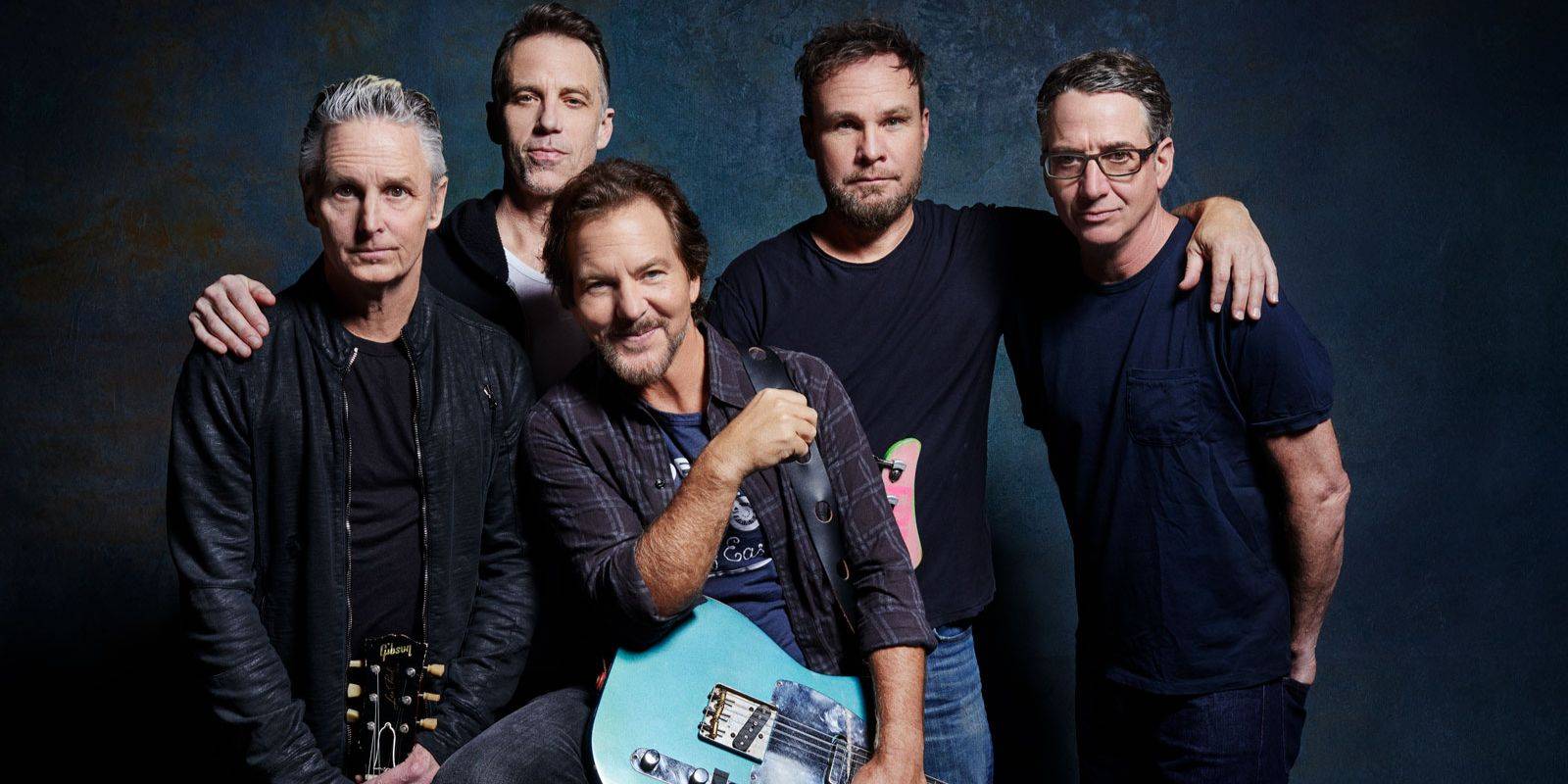
The rock band Pearl Jam Eddie Vedder and Mike McCready.Image via Pearl Jam
As a musician, you’ve written such iconic, amazing songs. I’ll use “Yellow Ledbetter” as an example. I love that song. It is a fucking masterpiece. MCCREADY: Oh, thank you. How is it when you’re performing something? You’ve probably played that song, and I’m lowballing it here, 10,000 times. What is it like as a performer when you’ve played it so much, and you’re playing it on stage? Is it weird to try to find the emotion every time? MCCREADY: No. It’s interesting. So, the trajectory of that song is I wrote that song before Pearl Jam. I had that riff when I was probably 21, and I’ve always had that whole thing. Then, when we were doing the first record, I started playing it, and I thought, “Okay, maybe I can get this song on the record.” Ed did one vocal pass of it, and then we never went back to it. So I was like, “Oh, man, it didn’t fucking make the first record.” I was kind of sad about it at first, but then it turned into this anthem that we end shows with over the years that has become bigger than anything that I ever imagined it would be, in terms of people have their own interpretation of what the lyrics are. I don’t know what the lyrics are, and I play the song all the time. And I haven’t gone to Ed to go, “Hey, what are you singing about?” I actually think it’s because you can’t understand the exact lyrics that you can use your imagination, and that is more powerful than anything Ed could say. MCCREADY: 100% agreed. Because each individual that hears a song has their context and their first time they ever heard it, or their love or their loss, or whatever they’re attaching to that song, to those lyrics that they don’t understand. Perfect. If you can have connection in a song, no matter what it is, with a multitude of people or one person, then you’ve done your job. So, I feel like “Ledbetter” is turning to this thing that’s bigger than all of us in the band, and it’s the reciprocity between the band and the fans. “Alive” is that way. “Alive” is turning from this song about Ed’s dad to this celebratory “we’re all still in this together with our fans.” And we feel that, the reciprocity live, as I do with “Ledbetter,” and that never gets old, and it always feels amazing. I travel a lot for work, and when I’m in a new city, often I have to work all day at the hotel, and I don’t even explore the city. You’ve traveled this planet. What is it like for you when you’re on a tour and you get into Dublin, whatever city it is, and you have a show that night? How do you spend your time during the day? What is it like for you when you are on tour, and you’re in a new city? Are you a homebody nowadays where you’re like, “I’ll just chill at the hotel,” or do you purposely make sure every day you’re going somewhere? MCCREADY: I am always making sure I go somewhere. I would go to Grafton Street, and I’d go look at the Phil Lynott statue or something. I need to go into the city. I need to have the vibe of the people and the environment so I can take that into the show at night. If I’m way too tired, I’ll chill out in the hotel, but I’m just too caffeinated. I need to see everything. So, if I have a day off in Dublin, I would go outside of the city, and there’s a place called Newgrange, which is a Neolithic village area that is 4,000 years old. I want to go see those things because we don’t have things that are that old here in the States. But if I’m in Boston, I’ll do the Freedom Walk or whatever. Or if I’m in California, I’ll go to the beach. I try to do whatever culturally is going on. If I’m in Prague, I’ll go walk the bridge. I love all that stuff. I would imagine one of the best perks of being a popular musician is that you have seen the entire planet in a way that most people will never see. MCCREADY: I think you’re right. Also, like you said, it’s a day here and a day there. I’m not there for a week straight, so I’ve got to get in what I can per day. If I’m in Rome, when in Rome, go see the Colosseum, or Verona, go see that Colosseum, or Venice, Ed and I paddle boarded around Venice one time. I mean, you get to do that kind of stuff. It’s rad. It’s like, “Wow.” I never expected I would ever do anything like that. So I try to be culturally aware. I’ll take my kids and my wife, and we all will book walking tours in England or in Berlin. I want to learn as much as possible while I’m on this planet. With musicians, Prince was famous for having the vaults of so many songs that were just sitting there, and demos, and he would record all night. As for the band, do you guys have a bunch of things that are in the vaults that have still never seen the light of day? MCCREADY: We don’t have as much as Prince [laughs], but we do have a vault, a literal vault full of all of our recordings that we’ve ever done. There are the beginnings of songs. There are songs that we’ve tried to work on a lot, and they never turn into anything. Once that happens, you kind of just put them away, and you move on to the next thing. So yeah, we have a lot more stuff. We released some stuff on this record called Lost Dogs a long time ago, and that was some of the stuff you’re talking about. So, yeah, there’s a whole other record that we were doing during the Gigaton session, of songs that never came out that are really cool. We did twice as many songs for the Gigaton record, so there’s a lot of stuff still waiting to come out. Again, we have to get together and talk about it and overanalyze it and beat it to death. It takes us a while to do these things as a band. Hopefully they come out someday. I really mean this, thank you so much for your music. You’ve been a part of my life for a very long time, and I really want to say a sincere thank you. MCCREADY: I appreciate that. I don’t take that lightly. If people like yourself are getting something out of our music, and it makes something better, then that’s what it’s all about. Farewell to Seasons is available to purchase now.
Active
1990 – Present
First Album
Ten
Album(s)
Ten, Vs., Vitalogy, No Code, Yield, Binaural, Riot Act, Pearl Jam, Backspacer, Lightning Bolt, Gigaton, Dark Matter
Number of Album(s)
12
Genre(s)
Grunge, Rock, Alternative Rock
Publisher: Source link


![‘Twilight’ Officially Meets ‘Blade’ in CBS’ New Vampire Sitcom [Exclusive]](https://www.filmibee.com/wp-content/uploads/2026/10/‘Twilight-Officially-Meets-‘Blade-in-CBS-New-Vampire-Sitcom-Exclusive.jpg)