
There’s a strong argument to be made that if you’ve read Quentin Tarantino’s “Once Upon A Time In Hollywood” novelization, “The Further Mis-Adventures Of Cliff Booth” shouldn’t surprise you. Tarantino’s book was shaggy and baggy, like an unedited, freehand version of the movie, full of detours, tangents, and narrative cul-de-sacs. An interesting extended curiosity, mildly entertaining in spots, but much of it probably wouldn’t have stood on its own outside the pulp novel format.
And yet, maybe it’s still a shock, nevertheless, that this is essentially the shape of this sequel, which feels written during the same creative jag: long, rambling, self-indulgent, and digressive. It has the loose, episodic quality of an Elmore Leonard-ish crime paperback, something you might enjoy for its colorful characters without expecting a compelling overarching story. But as a movie? It’s missing the snap and crackle of “Jackie Brown,” and the vibes are way off.
Then again, when Brad Pitt, David Fincher, and Tarantino want to make something together, the moneybags at Netflix are hardly going to say no. Three enormously powerful Hollywood talents returning to a beloved character. What could possibly go wrong? Well, plenty. Together, they can get virtually anything made, even material that might be laughed out of a regular studio development meeting without those names attached. It’s a shame Pitt and Fincher have devoted their considerable talents to what often feels like reheated QT leftovers, an occasionally amusing but frequently tiresome, juvenile lark that barely justifies its existence.
READ MORE: 88 Must-See Movies This Fall: ‘Dune: Part Three,’ ‘Digger,’ ‘Avengers: Doomsday,’ ‘The Adventures Of Cliff Booth’ & More
At least the title isn’t false advertising. These really are just further adventures of a character we already know, wandering through another series of encounters. Except the sun-dappled, halcyon days are over, and everything is decidedly seedier.
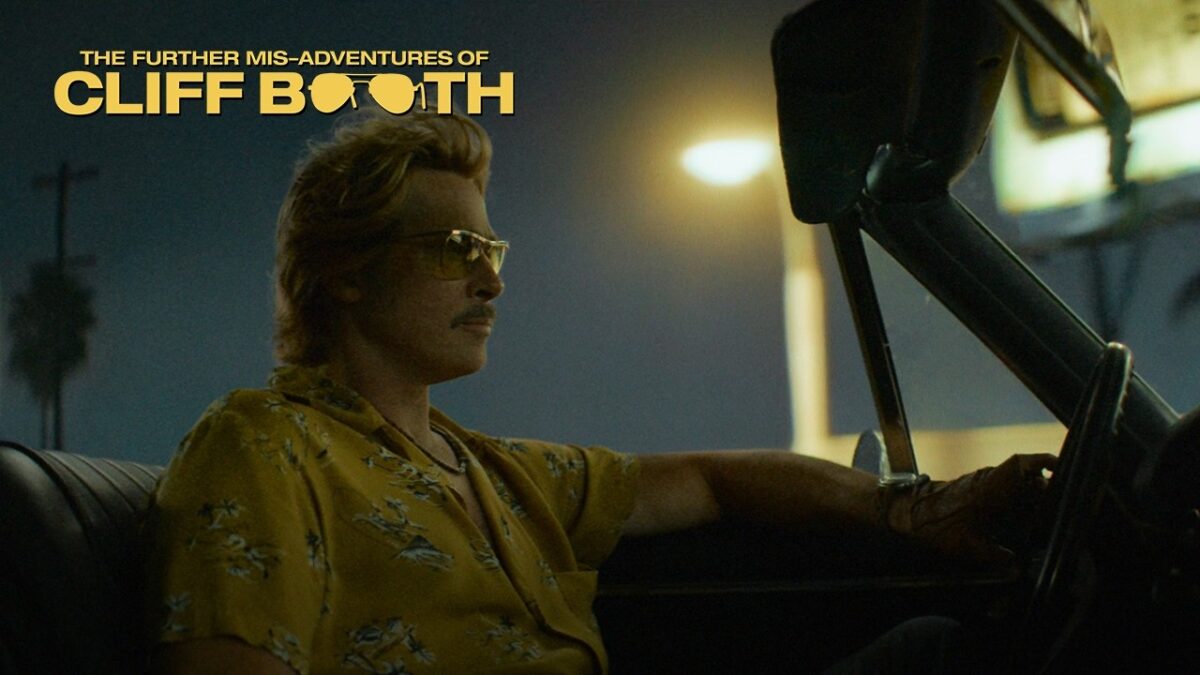
Set in 1977, eight years after ‘OUATIH,’ Hollywood has become a more cynical, dispiriting place. Rick Dalton has put on a few pounds and moved on to Australian television, Sharon Tate is doing Red Apple cigarette commercials, and Cliff Booth’s (Pitt) stuntman days are largely behind him. He makes ends meet by cobbling together gigs as a projectionist, bartender, and shady Hollywood fixer, getting producers and actors out of jams involving blackmail, theft, extortion, and worse.
He’s also living with his aging father, Gus (Peter Weller), in Marina del Rey. There’s something sweet about Cliff taking care of his dad, but also something depressing about a man seemingly past his prime. Like a teenager who peaked in high school, his greatest claim to fame remains beating up Bruce Lee, an incident repeatedly referenced by admirers, including a B-movie exploitation actor played by Yahya Abdul-Mateen II. It’s an amusing callback, but also a reminder that the world has moved on, even if Cliff hasn’t entirely caught up.
The misadventures begin when talent agent Karen Crosby (an excellent Elizabeth Debicki) approaches Cliff on behalf of her client, TV megastar Charlie Peters (Scott Caan, also very strong), a combustible, self-important actor with serious short king insecurity. Eventually, the predicament involves Peters’ wife Toni (Carla Gugino), an old flame of Cliff’s, and the Verdusco brothers (Matt Groove and JB Tadena), two vicious gangsters from Manila. Peters has gotten himself into a potentially deadly mess, and Cliff is enlisted to help clean it up, though the actor seems determined to take as long as humanly possible to explain what the hell he’s actually done.

That’s essentially the setup, though the movie takes an astonishingly long time to get around to it. Peters spends an eternity circling his predicament, dragging Cliff through a series of meetings while avoiding the point. At roughly two hours and 45 minutes, the film takes its sweet-ass time doing almost everything, and its lackadaisical narrative is both one of its intermittent pleasures and its greatest liability.
Ironically, the most engaging moments are often the most listless. The middle stretch, the hangout movie section, grows unexpectedly sunnier, largely because of the tentative courtship between Cliff and Crosby, Peters’ cynical, long-suffering agent. Debicki, all long-legged elegance and withering skepticism, initially wants little to do with this peculiar loser, who regards everyone with a mixture of amusement and contempt. But somehow, the son of a bitch starts winning her over.
That’s also one of the gifts of Pitt’s performance and QT’s characterization. As demonstrated in ‘OUATIH,’ particularly during the Bruce Lee sequence, Cliff is something of an unlikable jackass. Smug, self-righteous, condescending, and possessed of entirely self-appointed moral authority, he believes his personal code gives him permission to do virtually anything, including kick someone’s ass whenever he decides they deserve it. There’s an obnoxious certainty to him, a casually threatening arrogance that makes him someone you’d never particularly want to spend time with.
And yet, Pitt makes him effortlessly charismatic. The contradiction between Cliff’s easygoing demeanor and underlying menace, his affability and capacity for casual cruelty, remains his most fascinating quality. He’s resourceful, clever, occasionally thoughtful, even faintly romantic in his own creepy way. Crosby recognizes he’s a piece of work but gradually discovers his reluctant charms. So does the audience. You find yourself thinking, God, you’re such an asshole, only to admit a few scenes later that the bastard is kind of lovable.
The problem is that while Cliff remains an intriguing character, the movie surrounding him is considerably less so. It doesn’t deepen our understanding of him or reveal much beyond what the original film and Tarantino’s bleaker novelization already suggested. It simply gives him more opportunities to dispense his own brand of street justice against people so irredeemably awful that his brutality is supposed to seem comparatively reasonable.
The ugliness begins almost immediately. An early encounter involving a predatory criminal, a teenager, and a stolen Oscar establishes the film’s particularly unsavory atmosphere, with references to sexual exploitation and pedophilia handled in an aggressively sordid manner. Cliff takes matters into his own hands, demonstrating both his capacity for ruthlessness and selective compassion. It’s recognizably Cliff Booth, but the whole encounter leaves a nasty aftertaste.

Fincher’s involvement intensifies that impression. This is a Tarantino product through and through, although the director’s fingerprints occasionally appear in the visual presentation. Elaborate photographic montages, including a premiere sequence incorporating digitally manipulated images of old Hollywood stars, use flashing camera shutters to dictate the editing rhythm. Another still-photo sequence depicts Cliff partying and serving drinks. They’re technically accomplished Fincher flourishes, but oddly out of step with the screenwriter’s sensibility.
There’s also an argument that Erik Messerschmidt is a great Fincher cinematographer, but not necessarily a great Tarantino one. In a recent Empire interview, Tarantino even took a playful jab at Fincher’s lighting, suggesting his own cinematography was better. Clearly good-natured, but the visual distinction between the movies is glaring. Where Tarantino’s Los Angeles was sunny, warm, and nostalgic, Fincher’s is underlit, dank, and oppressive, amplifying the material’s already disreputable character.
Indeed, there’s a sickly, almost syphilitic quality to the movie, as if sitting in the theater where Cliff projects films might give you gonorrhea. Everything feels contaminated, like wandering into a rundown porno theater where you wouldn’t dare sit down. The visual murk makes the eruptions of violence that much more repellent.
Sonically, Trent Reznor and Atticus Ross offer surprisingly unobtrusive work, with funk and jazz-inflected compositions that could pass for forgotten soundtrack cues from the ’60s and ’70s, the kind Tarantino routinely excavates. It’s a departure from their more conspicuous electronic scores, though the music does little to counteract the prevailing atmosphere of decay.
Even the tentative romance is undercut by Tarantino’s crassness. Certain softcore pornography elements inspire the exasperated response, “Really? You had to write that?” It’s not prudishness; so much seems included simply because Tarantino can get away with it. The most disturbing example involves the Verdusco brothers, whose rampage includes a home invasion and the shooting of young innocents. It’s a grotesque, unnecessary choice. The brothers are already established as vicious criminals; their additional atrocities accomplish little beyond making the experience more odious.
Of course, Tarantino has never been especially interested in restraint, and the climax revisits the hyperviolent finale of “Once Upon A Time In Hollywood.” That film spent much of its running time as a sunny hangout before transforming into a savage revenge fantasy, its historical revisionism offering at least some emotional justification. Here, the carnage is similarly exaggerated, gleeful, and almost masturbatory, but without the underlying purpose. It’s another bloodbath that assumes we’ll find the spectacle inherently cool.
Except it isn’t particularly cool anymore. The whole enterprise feels dated, a familiar Tarantino indulgence that has lost much of its shock value. After gradually winning you over, the movie squanders that goodwill, falling right off a cliff into territory the filmmaker has already explored to diminishing returns.
Perhaps most frustratingly, Fincher, for all his occasional misfires, should be above this. A filmmaker of enormous precision and intelligence, he seems primarily concerned with servicing Tarantino’s screenplay, even when the material hardly warrants it. Their creative instincts don’t entirely mesh. The writer’s mischievous provocations acquire a harsher, more abrasive edge through Fincher’s aesthetic, and technical mastery can’t manufacture substance where there’s so little.
Ultimately, the movie feels like Hal Ashby with a switchblade, “Shampoo” with some kind of venereal disease. Ashby’s denim-clad, sideburned, doobie-fueled looseness was generally pleasurable, even when exploring melancholy and disillusionment. This is closer to his troubled, darker final years, when marijuana gave way to cocaine, amphetamines, and the red-eyed desperation of addiction.

“Cliff Booth” is really just another episode in this character’s life, something Pitt himself has conceded. Even Fincher initially questioned whether the sprawling material should be a movie or a television series. But an installment isn’t necessarily a compelling feature, especially one running nearly three hours with so little to say. Perhaps the larger meaning is that the fairy tale of the 1960s has ended, replaced by the grimier, bleaker Hollywood of the late post-Nixon, post-Vietnam ’70s. But even that might be giving Tarantino too much credit.
In the end, “The Further Mis-Adventures Of Cliff Booth” is like an older, eccentric uncle telling stories you don’t find nearly as funny or engaging as he does, too loudly and too close to your ear. He’s a little drunk, sloppy, spilling his drink, laughing at his own jokes, and far too enamored of his war stories. He slaps your back too hard, oblivious that his sense of what’s appropriate, amusing, or hip is generations out of date. You kinda love the guy, despite everything, but he’s so self-satisfied he never notices your kids staring at you with pleading eyes that silently scream, “Dad, God, can we go home already?”
That’s Cliff Booth, and unfortunately, that’s the movie, too. Occasionally charming, mildly entertaining, frequently off-putting, and wildly uneven, it’s a strangely purposeless undertaking from three enormously talented people who should probably have known better. [C]

Rodrigo Perez
Born in Chile, raised in Canada, now living in Brooklyn, NY, Rodrigo Perez is the founder and editor-in-chief of The Playlist, which he launched in 2007. He has worked in entertainment journalism since 2000, including at MTV, and has written for SPIN, IndieWire, Pitchfork, Complex, Magnet, MuchMusic, and various music, film, and entertainment publications over the past two decades.
Publisher: Source link