

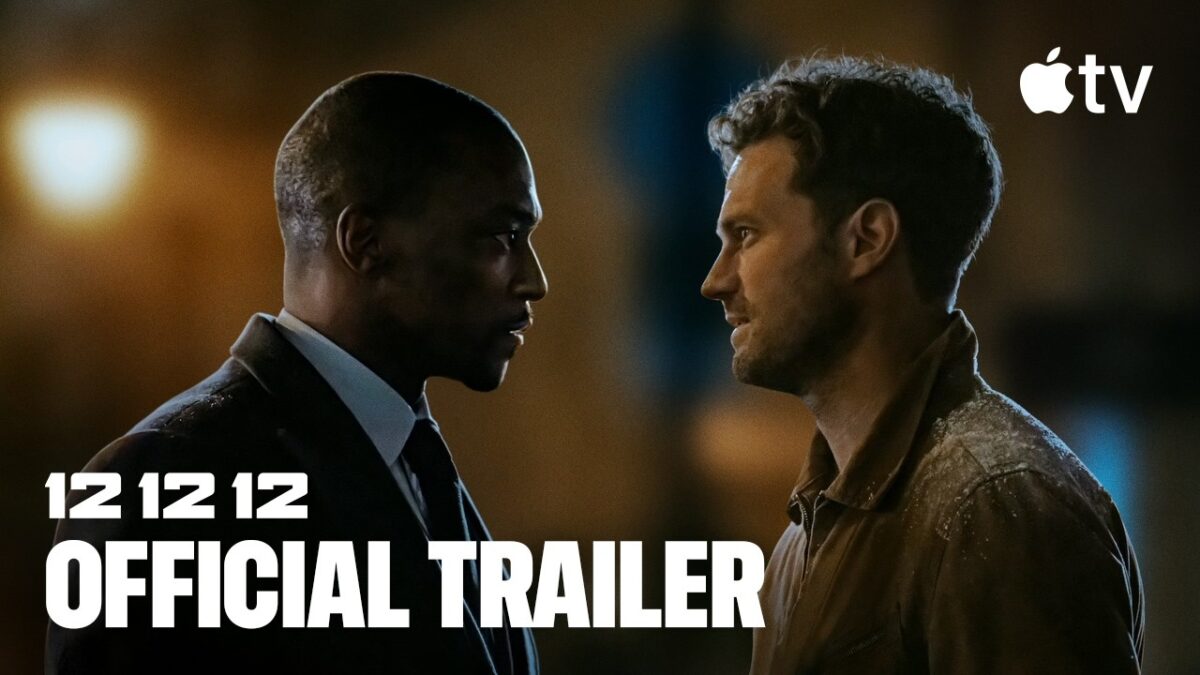
Thanks to the steadfast tutelage of Mr. Owl throughout the last five decades, it’s common knowledge that three licks are required to reach the Tootsie Roll center of a Tootsie Pop. Anyone born between the 1960s and 2020s is more likely to be able to answer that question faster than they can recite their own SSN. Less inculcated via pop culture osmosis is the total time investment needed to execute a world-class heist. For that, we have Anthony Mackie’s recurring voiceover in each episode of Apple TV’s slick crime series “12 12 12”: “A high-asset robbery, professionally conceived, is 12 months in planning, 12 hours in execution. A bank robber who is not caught within 12 days is not caught at all.”
It’s a neat hook, coolly delivered by Mackie’s line reading, and on paper, a sharp structural device for unspooling precisely such a caper over eight chapters totaling around eight hours of screen time. Put “12 12 12” in a bucket next to classic heist films like “The Sting” and the “Ocean’s Eleven” series. Creators and showrunners Jim Keeble and Dudi Appleton hew away from the comedy baked into those movies, though that’s not to say their work is humorless; the show plays wry and dry, perhaps a concession to its grounded, grittier backdrop. Realism appears to be the aspiration here, with a side of ambition: filtered into a brief, the series means to authentically represent the mechanics of setting up and pulling off a 10-digit robbery in a nigh-impregnable location from a high-profile mark, dividing each “12” in its title into A, B, and C plots from one episode to the next.
READ MORE: 62 TV Shows To Watch This Fall: ‘VisionQuest,’ ‘Blade Runner 2099,’ ‘East Of Eden,’ ‘Pride And Prejudice,’ & More
That fire in the belly is admirable, verging on irresistible. Part of a heist film’s pleasure is in the breakdown of the steps and phases of meticulously orchestrated larceny; watching the sausage get made is good fun, from technical details, à la engineering, to performed ones, à la glad-handing and misdirection. The movies conceive of a heist using the same language as a magic trick. “12 12 12” is no different from “Ocean’s Eleven” in that regard, save for the device used to divide each episode into the past, both further back and more recent, and the present; the more the story is splintered and the more attention must be paid to editing for the sake of continuity, the less effective the heist’s “abracadabra” quality becomes. Interesting as the temporal arrangements are conceptually, they suck all the air out of the room.
The show tries gamely, despite the accidental disadvantage it sets for itself. Mackie is in good form as Jack Strickland, a semi-disgraced FBI agent haunted by the death of his old partner on an assignment gone wrong; he’s hellbent on bringing Paul Galvin (Jamie Dornan), the man he holds responsible for her murder, to justice, which means he’s the exact wrong man for the job when Galvin does what so many career criminals do in heist yarns: accept One Last Job™, the big one, the one that’ll let him unshackle himself from his life of crime while also getting his big brother, Bobby (Jack Kesy), off his back. Like Mackie and Dornan, Kesy’s playing a type—big, boorish, brutish, the person on the crew with no interest in finesse or moral codes, and therefore a liability to everyone around him; unlike Mackie and Dornan, Kesy has limited breathing room in his stock role.
Grant that Bobby is a supporting character in the “12 12 12” ensemble, joined by Kali Reis, Ólafur Darri Ólafsson, Hildegard Schroedter, and Julius Feldmeier, among others, playing members of Paul’s team, and by Agathe Rousselle, playing his significant other, Severine. As just one among many, Kesy’s role in the larger story is narrow compared to either Dornan or Mackie. But the fact that he’s forced to embody such an unflattering trope is emblematic of how “12 12 12” runs into trouble. A series that affords itself an expansive enough palette to chronicle a year and change of granular preparation, with half a day’s worth of additional time to boot, shouldn’t leave a single character underdeveloped, and yet Bobby only becomes human and interesting in stray moments here and there, where he’s able to vent, even if only briefly, his fraternal resentments. The brothers had a rough upbringing. Paul, Bobby claims, gets to be Paul because of Bobby—the coarser man, the harder man, the man willing to do what it takes for his family, if not for a job.
These ideas become footnotes swallowed up in the march from one timeline to the next to the next after that, and frankly make more compelling drama than standardized character notes about, for example, Paul’s fatherhood anxiety and Jack’s workaholism as avoidance. (He’s grieving more than just his partner’s death, though the show holds that reveal in reserve until about halfway through the episode order.) Fair is fair: “12 12 12” is well-organized, a feat that, while totally unsexy on paper, is crucial for the show’s operation. An international crime saga told via a nonlinear narrative over months demands careful construction, just like Paul’s plan to nick a cool billion from oligarchs (because apparently a game of cops and robbers alone lacks sufficient stakes in 2026). That “12 12 12” manages to keep its threads straight is so impressive that the series’ entertainment value almost feels like a bonus; forgetting to have fun while making material shot in different locations and periods coherent seems like a risk.
Support independent movie journalism. Sign up for The Playlist Newsletter for the latest film and TV news, reviews, interviews, and more—free.
But “entertaining” is all that “12 12 12” gets to be. It’s slick, upscaled cotton candy, dissolving the moment we consume it; with all the opportunities available to find any substance in the scheming, the trade-off the show makes between pathos and empty calories is a disappointment.[C]

Andrew Crump
Bostonian culture journalist Andy Crump covers movies, music, television, politics,, and way too many other subjects for way too many other outlets, perhaps even some of yours: JoySauce, The A.V. Club, Pop Heist, Time, Men’s Health, and more. You can follow him on Bluesky and find his collected work at his personal blog. He’s composed of roughly 65 percent beer. Right now, he desperately needs a haircut.
Publisher: Source link