Whispers of Fire and Water Featured, Reviews Film Threat
Aug 24, 2023
LORCARNO FILM FESTIVAL 2023 REVIEW! Sab Khokla Hai Yahan (Translation: Everything is lifeless here. Hollow). Beyond the mining laborers, the water trucks, the torn-down one-room houses, and the landscape scenery, the land of Jharia is indeed hollow and lifeless – slowly and gradually burning down with the coal extracted from there for a century now. Shiva (Sagnik Mukherjee), an audio-installation artist, is visiting Jharia, India’s most significant coal field that has employed most of the local population forever. Recording and discovering various sounds from mining operations, Shiva finds himself amidst the complexity of coal mining’s impact on local life, which pushes him to unravel an understanding of the natural and industrial mysteries of the town.
Lubdhak Chatterjee’s screenplay and direction on Whispers of Fire & Water is an experiential telling where nature’s mystics contrast heavy machinery; locale contrast urbanization; black coal contrast lush-green landscapes; the chirping birds contrast dynamite explosions; and fire contrast water. Everything about the film takes precedence in these two rivaling elements and their traits that have forever shaped the locals’ lives, for better or worse.
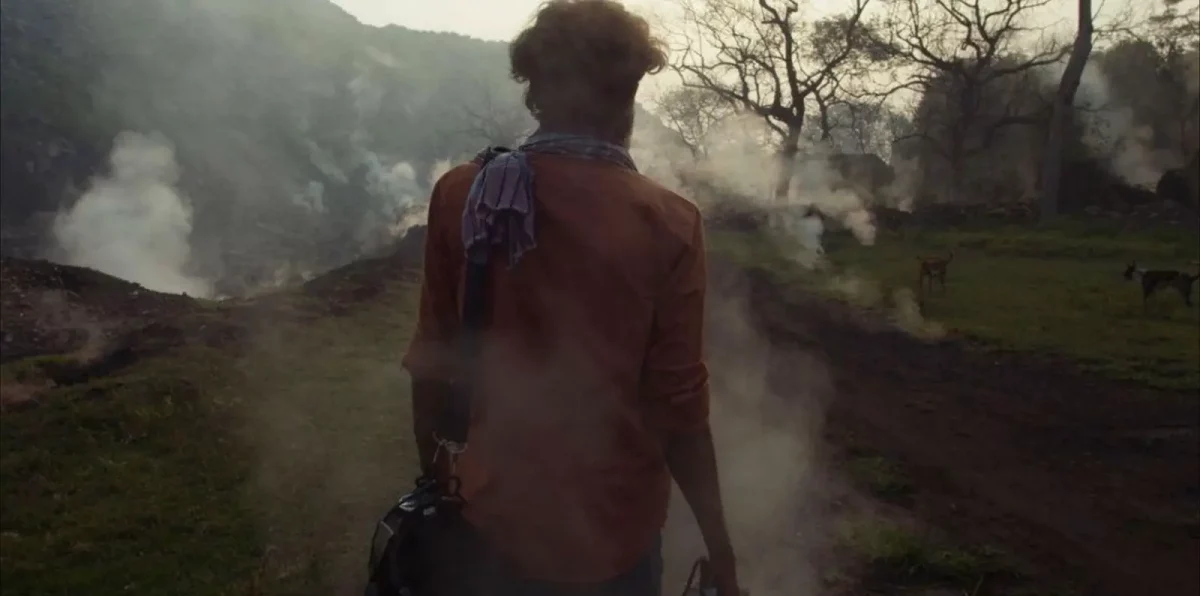
Whispers of Fire & Water begins with Shiva traversing the coalfield of Jharia and witnessing never halting mining and dumping operations with a workforce practically living amid the smoke. But Chatterjee halfway breaks the narrative and shifts directly to Shiva’s experience in the forest that serves as the native land for all who earn a living mining coal. While the coalfield has subjected these people to suffocation and breathlessness, their native, which they call home, has helped them cope and provided them with a freedom of life and short-lived peace. Juxtaposing Shiva’s two drastically distinct experiences through an impeccable combination of sight and sound eventually layer up all the allegory, thematic interpretations, and ambitious voices of Jharia, which Lubdhak so creatively and strikingly calls – Whispers.
“…narrates a juxtaposing commentary about the gradual decay and destruction of Jharia under industrial urbanization.”
When in the coalfield, Shiva is surprised by the destructive progression of life there. Though his job dictates he collects audio samples, he can’t help but witness the emptiness in the vast and widened layers of coal. Repeated oxidation has caused several piles of coal to burn throughout the day constantly. These fires, burning tonnes of coal to waste, have never been put entirely to rest for over a century. That’s a hundred years of uncontrolled air pollution, water contamination, and ground subsistence. And while the laborers continue to come under mining employment, they slowly lose their sustainable health and living. Through Siva’s stay near the field, Chatterjee indirectly takes us through workers’ plights which Shiva is subconsciously submitting himself. It’s a commentary on the nearly-dying cause of natural depletion and conservationism.
Yaha ka toh aapko pata hi hai (Translation: You know how it is here), remarks a local police officer, indicating rampant crime, systematic corruption, and authoritative loopholes in administration. A visiting journalist (Rohini Chatterjee) struggles to get officials’ comments on degrading climate conditions and workers’ lives, further stressing the concerns being downplayed in the region.
The sound of crackling coal, the invisible fires in the day, the explosions, and cranes engross the coalfields – echoing silent chaos in the life of workers. And as Shiva walks through the now-visible fires at night, we see workers inhaling toxic fumes and gases without gear and protection from piles of burning coal – resembling a crowd gathered around a pyre. By this time, the film has indeed captured what it hinted at in the beginning, which is the hollowness in the lives of Jharia. This is the whisper of Fire.
Chatterjee inspires a lot by Lav Diaz and slow cinema’s impactful traits and artistic ideologies. In several sequences, we see a stand-in camera just capturing the engulfing smoke, the burning pyres of coal, the mining explosions, and water trucks unsuccessfully trying to subdue the fires across several square miles of land. It feels like watching a two-dimensional frame from far away long enough to take in its true intent. Chatterjee also pushes us to watch Shiva closely in these stands-in frames, trying to get the best out of his expressions that resonate with the psychological implications of his experiences in the town.
Publisher: Source link






Alan Ritchson’s New 8-Part Action Thriller Lands Solid RT Score While Dominating Streaming
Alan Ritchson has, somewhat quietly, become one of streaming's more dependable stars, which is not necessarily where you would have expected his career to land back when he was doing Smallville supporting work and Blue Mountain State. Reacher turned him…
Sep 21, 2026

HBO’s Harry Potter Reboot Is Officially Ditching the Most Iconic Part of Daniel Radcliffe’s Era
This December, audiences will be transported back to the Wizarding world of Harry Potter. Of course, those born in the mid-to-late '90s will have fond memories of the movie franchise. Starring Daniel Radcliffe, Emma Watson, and Rupert Grint as Harry,…
Sep 20, 2026

‘Tracker’ Season 4 Officially Puts Its Biggest Mystery on Hold Despite Major Cast Comeback
Our fictional missing persons expert, Colter Shaw (Justin Hartley), has kept audiences happily on the edge of their seats ever since Tracker debuted two years ago, and Season 3 in particular left audiences with quite a major cliffhanger — all…
Sep 19, 2026

‘Reacher’s Action Thriller Spin-Off Gets Major Season 2 Update Following Premiere
For four seasons, Reacher has been one of the biggest TV shows on Prime Video. Based on the novels by Lee Child, the series follows former military police officer Jack Reacher (Alan Ritchson) as he wanders from place to place,…
Sep 18, 2026