A Delicate Look at the War in Ukraine Through the Eyes of Its Artists
Feb 17, 2025
The contradictions spelled out in Porcelain War’s title are mirrored in the film’s early scenes. Bucolic images of the Ukrainian countryside smash cuts to news footage of the Russian invasion that began back in 2022, the sunlit fields replaced with shattered piles of concrete, fires blazing from apartment buildings, jet fighters screaming overhead, and dramatic drumming adding a percussive jolt to emphasize the travails of a country at war.
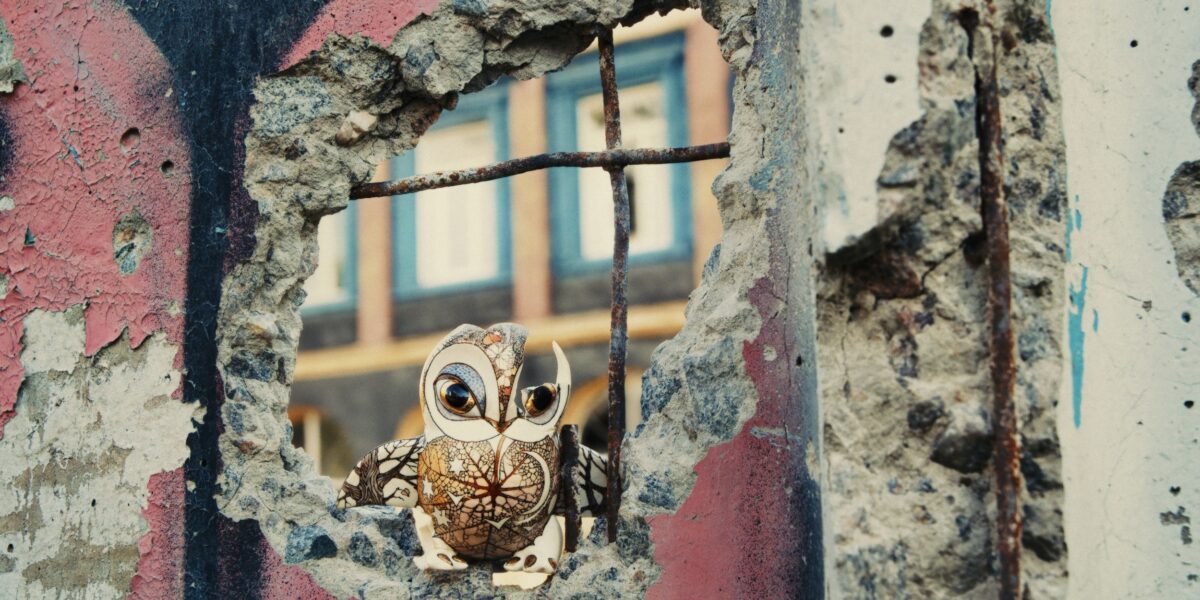
In the midst of the rubble, a finely painted owl made out of porcelain peaks out, its contemporary design evoking traditional artistry in the region, its beauty providing a stark contrast to the obliterated concrete and rusted rebar. It’s in this paradoxical environment where beauty and destruction meet that we encounter Slava, Anya, Andrey and Frodo the dog, four characters that help us as audience members experience these daily contradictions experienced in their besieged town of Kharkiv.
‘Porcelain War’ Shows the Difficulties of Creating Art During Conflict
We learn that Slava and Anya’s connection goes back to their early childhood – Anya traded a stuffed rabbit to Slava’s mother for a chance to push him around in a stroller and feed him porridge, and they both admit that all these decades later she’s still pushing him around. We see Slava sculpting delicate porcelain figures, while Anya’s task is to paint the glaze atop, bringing the sculptures (almost all of them of woodland “beasts” endemic to the area) to life. The metaphor for the Ukrainian people and its culture is made manifest: Porcelain is both fragile and immortal, able to be resurrected millennia after being damaged. Through the work of Slava and Anya, we see how the beauty of art manages to shine through even the horrors of a battle-scarred region. The two are but “ordinary people in an extraordinary situation,” as Sasha explains, bemoaning how the elements that define a culture are among the easiest erased when a country shifts from civilian to war footing. The same hands that so delicately carved the figurines are soon seen disassembling an assault rifle, trading the tools of the arts for the tools of combat.
‘Porcelain War’ Presents Larger Issues Explored Through Tiny Acts of Preserving Culture
Image via Picturehouse
Larger questions about the geopolitical situation, such as how the nuclear disarmament after the collapse of the Soviet Union brought with it security assurances, are intelligently discussed, if done with a heavy sigh. There’s palpable disgust at the international community’s paltry response to Russian aggression expressed by the otherwise soft-spoken Sasha, a quiet yet forceful rage at being forced to confront such aggressions. While training absolute neophytes to fight – doctors, scholars, artists – we witness firsthand the necessary transformation from civilian to military life, a new form of molding men and women to fight, rather than porcelain to be admired for its delicacy and beauty.
Scenes of nature are continuously contrasted with the more ominous warnings of coming battles—made all the more austere given all that’s transpired since the film’s creation more than two years ago. The area the film represents has gone through further incalculable destruction, and while Porcelain War provides a unique insight into a particular window of time, there’s much in the way of horror that lies beyond its scope. As of this writing, this mode of destruction continues unabated with the peaceful, pastoral images presented here trampled more and more with every hour.
Of course, while the recent escalation of conflict demonstrates a massive shift in both policy and the brutality of battle, this conflict with Putin’s Russia did not start a mere few years ago. Andrey, a friend of Slava and Anya who is a painter and budding cinematographer, was also forced to leave his home in Crimea during that invasion way back in 2014. He speaks of being lost after being displaced, finally finding a home in Kharkiv near these friends who have become closer than family.
The fact that his new home would years later be under similar bombardment is but one of the tragic ironies of trying to find a safe space when the specter of war is ever-present. Along with Slava, Andrey began recording images of the early stages of the most recent conflict, capturing with their artistically-honed gaze the appalling destruction and the captivating, macabre beauty that’s the inexorable result of conflicts since the dawn of time.
‘Porcelain War’ Is a Documentary Crafted by Those in the Thick of Bombardment
Image via Picturehouse
With consumer cameras and a few simple filming rigs, they seek to tell the story of their city as a mode of survival, both aesthetic and actual. Through their eyes, we bear witness to a collapsing major metropolis, the physical scars on the building, and the haunting absence of those who called this place home, a prime exemplar of just what’s being lost during this terrifying moment in history. A title card at the film’s start states that the subjects shot the majority of the footage, and Slava is credited as co-director along with American filmmaker Brendan Bellomo in assembling the pieces into a whole.
The contrast between the meticulous beauty of the painted sculptures and the mangled landscape is palpable, but these elements are given even more narrative heft when Anya’s illustrations seemingly come to life, the still designs animated in a charming, flowing manner. It’s this continuous collision between the whimsical artistry exemplified by the sculptures, and the more sordid scenes of a city under siege, that gives the film its most stark effect. Finding moments of tranquil beauty in such a space feels at best trivial, and at worst naïve, as if one is simply adhering to normalcy in a completely irrational fashion. Yet as the three artists demonstrate, as per the film’s ethos as a whole, it’s these deeply humanist moments that make the battles worth fighting, for it is this beauty that’s under threat, and these moments of grace that are being clung to against all the odds.
Related
This Heart-Wrenching Oscar-Nominated Documentary Captures How Art Brings Hope in Times of Crisis
A story of ordinary people in an extraordinary situation.
The result makes Porcelain War one of the more gentle if powerful looks at a nation at a precipice, illustrating the sacrifices that must be paid. We’re shown that it’s the artistic aspects that are the most ephemeral yet most impactful element under threat from this conflict, as existential as any aspect of what’s taking place on the battlefront. The war in Ukraine isn’t simply one of territoriality, it’s one of cultural erasure, and those who seek to continue the process of expressing these facets through their art, be it in the form of painting, sculpture, or these filmed images themselves, are themselves giving strength to their National cause.
For beyond bullets and weaponry, the art itself proves to be a mode of resistance; the designs serve as commemorations of past events that should never be forgotten, the sculpted creatures serve as mute witnesses to horrors, and equally standing proud as icons to be venerated as emblematic of a long and deeply routed nation being pushed to its limit by invading forces. In the same way, the very act of filmmaking itself helps Porcelain War battle against those that wish to erase this delicate yet resilient culture.
Porcelain War
Brendan Bellomo and Slava Leontyev’s powerful doc shows artists still working on their craft, despite the war going on around them.
Release Date
November 22, 2024
Runtime
87 minutes
Director
Slava Leontyev, Brendan Bellomo
Writers
Slava Leontyev, Brendan Bellomo, Paula DuPré Pesmen, Aniela Sidorska
Cast
Pros & Cons
Elegantly shot film that captures the paradoxical beautiy and horrors of a Nation at war
Accessible, even whimsical at times while never forgetting the larger story
A moving film with global resonance
Occasionally loses its way, but quickly recovers
Publisher: Source link





Disney+ Officially Exploring Major Streaming Platform Change
With Toy Story 5 making big bucks at the box office and The Devil Wears Prada 2 crushing the streaming numbers, Disney is poised to keep the momentum going. The media giant has been cutting hundreds of jobs in addition…
Aug 6, 2026

‘Baywatch’ Reboot Officially Confirms Streaming Release Details
When Baywatch signed off in 2001, it had already spent the better part of a decade as the most-watched show on the planet, airing in more than 200 countries and reaching over a billion viewers a week at its peak.…
Aug 5, 2026
Origins’ Sets Return Date With Mark Harmon Getting a Season-Long Arc
Mark Harmon played special agent Leroy Jethro Gibbs for 18 seasons of NCIS before leaving in Season 19. The original show has soldiered on without him — it will soon be back for its 24th season — but the franchise…
Aug 4, 2026
Forget ‘Lioness,’ Paramount’s 114-Episode Non-Stop Action Thriller Is One of the Biggest Shows on Streaming
Taylor Sheridan's hit action thriller, Spec Ops: Lioness, is nearly back with its third season. Season 3 of Lioness debuts on Aug. 2, dropping a new episode each week. While Taylor Sheridan fans are re-watching the series (and Sheridan's other…
Aug 3, 2026