A Quiet, Harrowing Portrait of Grief and Guilt
Apr 25, 2025
We all know that Michael Shannon is a highly talented actor, but with the release of his directorial debut feature film Eric LaRue, we now know that he’s just as skilled behind the camera. This is a sobering, intricately woven drama that plunges into the uneasy emotional terrain left behind by a school shooting—not from the perspective of the victims’ families, as is common in such narratives, but through the eyes of the shooter’s mother. Based on Brett Neveu’s 2002 play (which Neveu adapted for the screen), the film explores a seldom-considered facet of grief, where shame, guilt, isolation, and the desperation for forgiveness battle against the paralyzing weight of public judgment and private devastation.
Judy Greer’s Masterclass in Restraint:
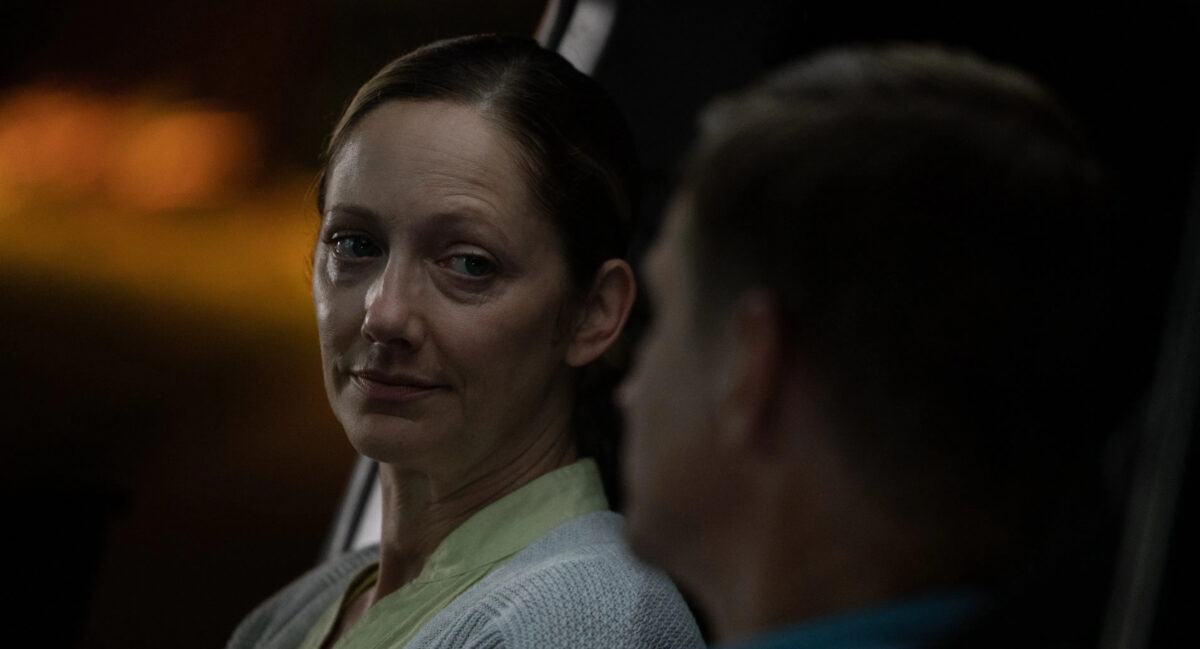
Judy Greer, in a career-best performance, plays Janice LaRue, a woman shattered and haunted by the horrific actions of her teenage son, Eric. He’s committed an unthinkable crime: murdering three of his classmates in a school shooting. Janice is left to face the incomprehensible wreckage—not just the loss of her child to incarceration (and perhaps to moral irredeemability), but the overwhelming burden of societal scorn and internal torment. Shannon doesn’t approach this material with sensationalism or melodrama; instead, he favors a naturalistic, contemplative tone that’s patient, even uncomfortable in its stillness, letting us sit with Janice’s pain without rushing to resolve it.
The film finds Janice in emotional stasis, moving through her daily routine like a ghost. Her voice is quiet, her body stiff, her expressions unreadable. It’s clear she has no roadmap for grief this unique, no handbook for how to mourn when your child is the cause of others’ mourning. Greer’s performance is a study in restraint. Rather than delivering grand monologues or overt emotional breakdowns, she captures the essence of a woman who is barely functioning—who is deeply aware that she has become a symbol, a scapegoat, and perhaps an emotional orphan.
A Marriage Divided by Grief:
Janice’s husband, Ron (played with a muted, weary kindness by Alexander Skarsgård), seeks comfort in a new evangelical church led by Bill Verne (Tracy Letts), a swaggering motivational preacher who offers hope in digestible platitudes. Their spiritual journeys diverge. While Ron turns toward a God of deliverance, Janice remains locked in a spiritual vacuum. Her own pastor, Steve Calhan (Paul Sparks), encourages her to meet with the mothers of Eric’s victims as a step toward healing. It is not so much forgiveness he suggests but communion—an exchange of grief that might help both sides feel less alone.
The Unbearable Weight of Confrontation:
But the idea is repugnant to Janice. What could she possibly say to them? How could she dare occupy the same space, much less speak of sorrow? She is frozen not only by shame but by the profound knowledge that no apology, no explanation, could ever bridge the chasm created by her son’s violence.
When Janice finally does agree to meet the mothers, the film becomes something more than a portrait of grief—it becomes a terrifying exercise in emotional exposure. The scene is quiet, painfully realistic, and nearly unbearable to watch. Alison Pill is especially strong as Lisa, a woman whose managerial composure masks profound inner devastation. There is no screaming match, no cathartic release, only the unbearable awkwardness of sharing oxygen with someone forever tied to your worst moment.
Shannon’s Confident, Understated Direction:
Michael Shannon’s direction is remarkably confident for a first-time filmmaker. Rather than embellishing with flashy visuals or kinetic editing, he places trust in the material and the performers. The camera lingers on silences, awkward conversations, and emotionally fraught stillness. This choice occasionally risks stagnation, but more often it deepens the realism and forces us to stay in the uncomfortable emotional space Shannon so carefully constructs. His background as an actor shows; every performance is deeply felt, even in characters we only briefly meet.
Faith as a Battlefield:
Paul Sparks’ performance as Pastor Steve is one of quiet desperation—a man trying to shepherd a soul who might no longer believe in salvation. His scenes with Janice are particularly tender, emphasizing the limits of faith when confronted with the incomprehensible. Meanwhile, Tracy Letts as the charismatic preacher Bill Verne is a compelling foil to Steve. Where Steve is unsure and compassionate, Bill is polished and performative. Through them, the film explores different expressions of faith—one grounded in doubt, the other in certainty. It’s clear that neither path is fully satisfying for Janice.
Where the Film Stumbles:
The film is not without its flaws. At times, the pacing feels sluggish, especially in the middle stretch where Janice’s emotional inertia begins to weigh on the narrative itself. Shannon’s minimalist style—while appropriate for the heavy material—can feel overly austere, bordering on monotonous. There are moments where one longs for more visual or emotional variation, some change in rhythm to provide relief or momentum.
Additionally, while Greer’s performance is masterful, Janice is such a withdrawn, opaque character that it can be challenging to emotionally connect with her. This is no fault of the actor, but of the screenplay’s strict adherence to internalization. A few more glimpses into Janice’s past, or her relationship with Eric before the tragedy, might have enriched the character’s emotional landscape and given the audience a more layered sense of her journey.
A Quiet, Unflinching Look at Moral Ambiguity:
That said, Eric LaRue is a rare and valuable film for its willingness to address a deeply uncomfortable subject without succumbing to didacticism or emotional manipulation. Shannon and Neveu resist any temptation to offer easy answers or moral clarity. This is a film about the irreconcilable—the parts of life where language fails, where faith falters, and where healing may not be possible, only endured.
The final scenes suggest the beginning of a fragile reckoning, but not resolution. And that is perhaps the most honest and powerful note the film could end on. In an era of polarized discourse, where stories of gun violence are often politicized or simplified, Eric LaRue offers a quiet, complex, and humanistic look at the collateral damage left in the wake of such horror—not just for those who lose their loved ones, but for those who are left to live with the unthinkable acts committed by their own family.
Overall:
Eric LaRue is not an easy film to watch, nor is it meant to be. It is a raw, unvarnished meditation on guilt, grief, and the elusive nature of redemption. Michael Shannon proves himself a filmmaker of patience and compassion, and Judy Greer delivers a devastatingly understated performance that deserves more recognition than it’s likely to receive. Though uneven at times, the film’s emotional honesty lingers long after the credits roll.
Eric LaRue Review: A Quiet, Harrowing Portrait of Grief and Guilt
Acting – 8/10
Cinematography/Visual Effects – 7/10
Plot/Screenplay – 7.5/10
Setting/Theme – 7/10
Watchability – 7/10
Rewatchability – 5/10
User Review
0
(0 votes)
Summary
Eric LaRue is not an easy film to watch, nor is it meant to be. It is a raw, unvarnished meditation on guilt, grief, and the elusive nature of redemption. Michael Shannon proves himself a filmmaker of patience and compassion, and Judy Greer delivers a devastatingly understated performance that deserves more recognition than it’s likely to receive. Though uneven at times, the film’s emotional honesty lingers long after the credits roll.
Pros
Judy Greer delivers a career-best performance
Michael Shannon proves himself to be a solid talent behind the camera
A raw and unvarnished meditation on guilt and grief
Cons
Sluggish pacing
We don’t get to know too much about our lead character
.review-total-box {
display: block;
}
.wp-review-1001907.review-wrapper .user-review-area .review-percentage,
.wp-review-1001907.review-wrapper .user-review-area .review-point {
width: 20%;
float: right;
margin-top: 5px;
}
.wp-review-1001907.review-wrapper.wp-review-circle-type .review-total-wrapper .review-circle.review-total {
margin: auto 0;
padding-top: 15px;
width: auto;
height: 100%;
clear: both;
}
.wp-review-1001907.review-wrapper.wp-review-circle-type .review-total-wrapper > .review-total-box {
display: block;
}
.wp-review-1001907.review-wrapper.wp-review-circle-type .review-total-wrapper > .review-total-box > div { display: none; }
.wp-review-1001907.review-wrapper .review-total-wrapper .review-total-box h5 {
color: inherit;
}
.wp-review-1001907 .review-embed-code { padding: 7px 30px 15px; }
.wp-review-1001907 .review-embed-code #wp_review_embed_code { background: rgba(255, 255, 255, 0.5) }
.wp-review-1001907 .wpr-rating-accept-btn {
background: #e57e34;
background: linear-gradient(to top, #e57e34, #f08436);
color: #000000;
margin: 10px 30px 12px;
width: -moz-calc(100% – 60px);
width: -webkit-calc(100% – 60px);
width: -o-calc(100% – 60px);
width: calc(100% – 60px);
border-radius: 50px;
}
@media screen and (max-width:600px) {
.wp-review-1001907.wp-review-point-type .review-list li .review-point,
.wp-review-1001907.wp-review-percentage-type .review-list li .review-percentage {
width: 40%;
}
.wp-review-1001907.wp-review-point-type .review-list li .wp-review-user-rating .review-point,
.wp-review-1001907.wp-review-percentage-type .review-list li .wp-review-user-rating .review-percentage {
width: 100%;
}
.wp-review-1001907.wp-review-point-type .wpr-user-features-rating .review-list li span,
.wp-review-1001907.wp-review-percentage-type .wpr-user-features-rating .review-list li span {
float: left;
line-height: 1.4;
font-size: 14px;
}
.wp-review-1001907.review-wrapper .review-pros-cons .review-pros {
padding: 15px 30px;
}
.wp-review-1001907.review-wrapper .review-pros-cons .review-cons {
padding: 15px 30px;
padding-top: 0;
}
.wp-review-1001907.review-wrapper .user-total-wrapper {
max-width: 100%;
float: left;
}
.wp-review-1001907.review-wrapper.wp-review-circle-type .user-total-wrapper { max-width: 70%; }
.wp-review-1001907.review-wrapper .user-total-wrapper h5,
.wp-review-1001907.review-wrapper .user-total-wrapper .user-review-title { font-size: 14px; }
.wp-review-1001907.review-wrapper .user-review-area .review-percentage,
.wp-review-1001907.review-wrapper .user-review-area .review-point {
width: 50.5%;
}
.wp-review-1001907.review-wrapper .review-links { padding: 15px 30px 5px; }
}
@media screen and (max-width: 480px) {
.wp-review-1001907.review-wrapper .reviewed-item,
.wp-review-1001907.review-wrapper .review-desc { padding: 15px; }
.wp-review-1001907 .review-list li,
.wp-review-1001907.wp-review-point-type .review-list li,
.wp-review-1001907.wp-review-percentage-type .review-list li,
.wp-review-1001907.review-wrapper .wpr-user-features-rating .user-review-title,
.wp-review-1001907.review-wrapper .user-review-area,
.wp-review-1001907.review-wrapper .review-pros-cons .review-pros,
.wp-review-1001907.review-wrapper .review-pros-cons .review-cons,
.wp-review-1001907.review-wrapper .review-links,
.wp-review-1001907.review-wrapper .review-embed-code { padding: 12px 15px; }
}
]]>
Publisher: Source link









Disney+ Officially Exploring Major Streaming Platform Change
With Toy Story 5 making big bucks at the box office and The Devil Wears Prada 2 crushing the streaming numbers, Disney is poised to keep the momentum going. The media giant has been cutting hundreds of jobs in addition…
Aug 6, 2026

‘Baywatch’ Reboot Officially Confirms Streaming Release Details
When Baywatch signed off in 2001, it had already spent the better part of a decade as the most-watched show on the planet, airing in more than 200 countries and reaching over a billion viewers a week at its peak.…
Aug 5, 2026
Origins’ Sets Return Date With Mark Harmon Getting a Season-Long Arc
Mark Harmon played special agent Leroy Jethro Gibbs for 18 seasons of NCIS before leaving in Season 19. The original show has soldiered on without him — it will soon be back for its 24th season — but the franchise…
Aug 4, 2026

Forget ‘Lioness,’ Paramount’s 114-Episode Non-Stop Action Thriller Is One of the Biggest Shows on Streaming
Taylor Sheridan's hit action thriller, Spec Ops: Lioness, is nearly back with its third season. Season 3 of Lioness debuts on Aug. 2, dropping a new episode each week. While Taylor Sheridan fans are re-watching the series (and Sheridan's other…
Aug 3, 2026