
As a culture, as a whole, we could really stand to make clearer distinctions between what’s a perfect replication or approximation of a piece of art and what is, in fact, good art. Take “Blade Runner 2099,” the new Prime Video series from Silka Luisa, the creator and showrunner behind the absorbing Elisabeth Moss-led sci-fi, time-travel miniseries “Shining Girls,” for example. Taking its spiritual cues from Ridley Scott’s original “Blade Runner” film—but less so from Denis Villeneuve’s belated “Blade Runner 2049” sequel—this new series nails the iconically moody, brooding, rain-soaked dystopia Scott originated. Visually, musically, sonically, aesthetically, the entire thing feels like you’ve been dropped into his carefully crafted, singular universe.
READ MORE: 62 TV Shows To Watch This Fall: ‘VisionQuest,’ ‘Blade Runner 2099,’ ‘East Of Eden,’ ‘Pride And Prejudice,’ & More
And that’s great and all, but approximation is not, in and of itself, a virtue. And moreover, if Scott’s movie was set in 2019, and it’s now 2099, shouldn’t culture, technology, or, well, something have changed, advanced, or even looked different? It’s one of the show’s mildly distracting qualities: it replicates mood, tone, atmosphere, and feeling—ironic, considering the subject matter—but doesn’t really push the universe much further. At least aesthetically.
Narratively, the series introduces a major reversal: humans are now the underclass, and replicants have become the dominant species. Yet for all the careful craftsmanship involved in recreating this world, “Blade Runner 2099” struggles with something considerably more fundamental. It’s gorgeous to look at, often mesmerizing to listen to, and surprisingly difficult to care about.
Set 50 years after the events of “Blade Runner 2049,” the eight-episode series opens with a brief history of how civilization reached this point. Replicants, originally created to serve humanity and populate off-world colonies, eventually overthrew their human creators. And so the tables have turned: humans have been relegated to the menial labor they once forced upon replicants, while a special replicant police force hunts down those who refuse to surrender. Additionally, the series largely sidesteps Villeneuve’s “2049” and how synthetic farming had averted famine amid ecological collapse. Here, the prologue rather casually explains that replicants have since begun restoring Earth’s devastated ecosystems.
Its clever franchise inversion should open further doors to existential questions about power, consciousness, identity, and what it means to be human. Unfortunately, the series has considerably more success establishing this compelling new status quo than making its characters or mysteries particularly engaging.
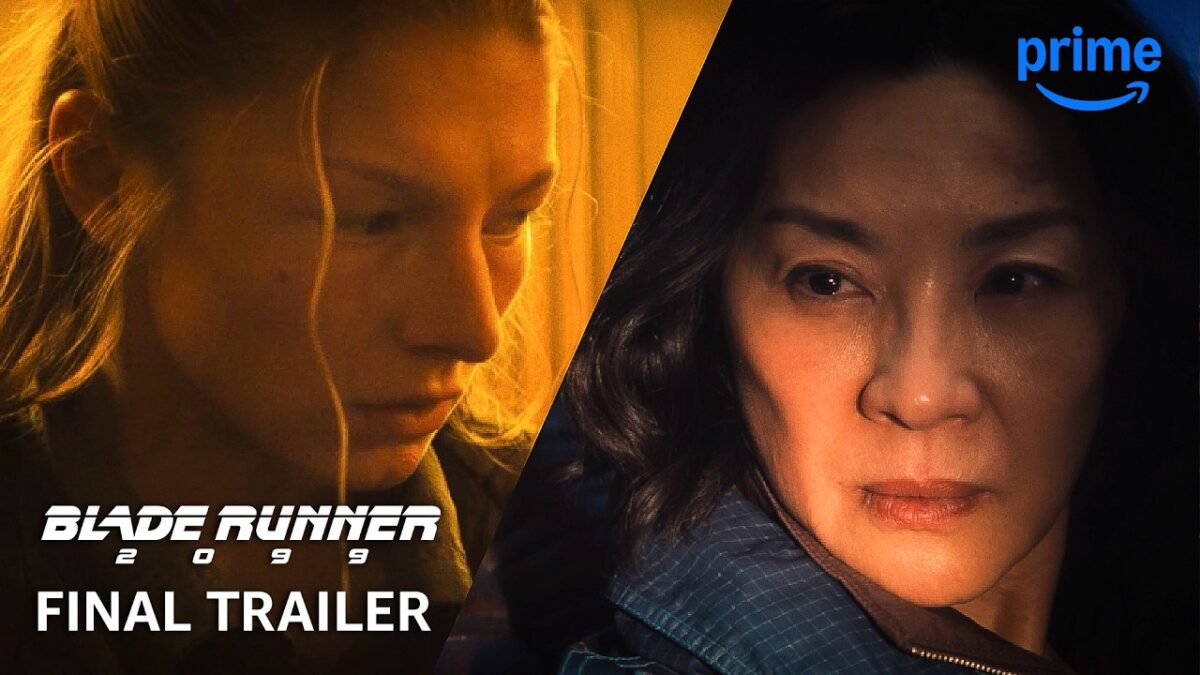
Hunter Schafer plays Cora, a human fugitive forced into hiding after a Blade Runner raid, desperate to escape Los Angeles with her ailing brother Elias (Lewis Gribben). Mexico City is rumored to be a sanctuary for humanity, and her friend Bebeto (Dimitri Abold), a black-market fixer with ties to the human resistance, offers to arrange safe passage if she retrieves a mysterious object.
To do so, Cora must infiltrate the replicant police force, undergo physical alterations, and impersonate a Blade Runner transferred from an off-world colony, concealing virtually every recognizable trace of her humanity.
Meanwhile, Michelle Yeoh plays Olwen, a veteran replicant Blade Runner nearing the end of her predetermined lifespan. With days remaining before her expiration, her body is deteriorating, including a troubling loss of muscular control. She’s searching for Marek (Johnny Harris), a former partner who has disappeared. Flashbacks suggest their relationship may have extended beyond professional loyalty, perhaps even resembling love—or an attachment her programming shouldn’t technically permit. Her younger colleague Yahya (Matthew Needham) embodies a particularly unforgiving side of replicant culture, convinced that humans deserve the mistreatment they once inflicted upon their creations. Abuse of power comes as no surprise.
Eventually, Cora is paired with Olwen, creating a potentially intriguing dynamic: one character is a human desperately trying to pass as something inhuman, while the other is an artificial being confronting mortality and perhaps discovering feelings she shouldn’t possess. But while Yeoh and Schafer are perfectly adequate, and appropriately aloof given their characters, their relationship never develops much emotional traction. The performances aren’t necessarily the problem; the writing simply struggles to make these guarded, distant individuals compelling.
To its credit, the series occasionally introduces imaginative details that suggest a more intriguing exploration of replicant society. One peculiar development involves an underground red light district where artificial beings indulge in approximations of human experiences. Unable to reproduce or undergo certain biological changes, they purchase elaborate prosthetics and body modifications, trying on pregnancy, different physical appearances, and other aspects of human existence. It’s a strange, vaguely disturbing kind of biological cosplay, and one of the more inventive attempts to imagine how replicant society might develop its own desires and peculiar cultural obsessions. The notion that beings who have conquered humanity would become fascinated with imitating its biological imperfections is especially interesting.
But the concepts are frequently more interesting than the drama. Marek’s disappearance and the threat of Cora’s exposure propel the story, yet the mystery is never very involving. There’s also the nagging question of how Cora fools a society of supposedly superior artificial beings. Despite her physical alterations and emotionally hardened demeanor, she repeatedly evades detection, including during examinations reminiscent of the original film’s famous Voight-Kampff test. It takes a fair amount of squinting to maintain one’s suspension of disbelief. Hardly a deal-breaker, but an irritation the show isn’t engaging enough to make you overlook.
Technically, however, “Blade Runner 2099” is often exceptional. The opening episodes, directed by Jonathan van Tulleken, establish a remarkably convincing continuation of the franchise’s aesthetic. A flashback set in 2023 feels like a deleted scene from Scott’s original; the texture, smoke, and lighting are virtually indistinguishable. The cinematography, led by Rob Hardy, beautifully renders the imposing architecture and oppressive atmosphere of retrofuturistic Los Angeles. The production design and visual effects are meticulous, while Leopold Ross’ score delivers ominous synthesizers and melancholy textures. The sound design, with its industrial hums and ambient unease, is equally evocative. These craftspeople have done extraordinary work, and on a purely sensory level, the series can be stunning.
Perhaps the larger problem is whether “Blade Runner,” with all its philosophical, existential preoccupations, naturally lends itself to television. Scott’s original and Villeneuve’s sequel are deliberately paced, contemplative films, but their mysteries and meditations on mortality have a cumulative emotional effect. Stretch that sensibility across eight episodes, and what registers as brooding and hypnotic in a feature can become sluggish and repetitive when serialized. There’s a fine line between hypnotic and soporific, and “Blade Runner 2099” crosses it more often than it should.
That’s especially disappointing because Luisa already proved with “Shining Girls” that ambitious science-fiction concepts can coexist with gripping, emotionally resonant storytelling. That series explored fractured reality and existential uncertainty through a protagonist whose trauma gave its mysteries real stakes. Here, despite the elaborate world-building, those ideas never acquire the same psychological weight.
There’s a delicious contemporary irony to all this, especially in an age when AI can conjure up a remarkably convincing action scene between Tom Cruise and Brad Pitt. It can look startlingly real, but the resulting slop is laughably devoid of human soul, intelligence, and genuine artistry. “Blade Runner 2099” is obviously the product of enormously talented human craftspeople, but the underlying distinction feels especially relevant. You can reproduce the appearance of something almost perfectly without capturing the elusive qualities that made it meaningful in the first place, and you can pour all your heart, soul, blood, sweat, and tears into it and still end up with something that feels coldly generative.
Support independent movie journalism. Sign up for The Playlist Newsletter for the latest film and TV news, reviews, interviews, and more—free.
“Blade Runner 2099” isn’t a bad series. It’s beautifully realized, intermittently intriguing, and full of ideas that deserve further exploration. But for a franchise fundamentally obsessed with the nature of humanity, it’s remarkable how emotionally hollow this latest installment feels. All that extraordinary craftsmanship, and still so little reason to care. [C]

Rodrigo Perez
Born in Chile, raised in Canada, now living in Brooklyn, NY, Rodrigo Perez is the founder and editor-in-chief of The Playlist, which he launched in 2007. He has worked in entertainment journalism since 2000, including at MTV, and has written for SPIN, IndieWire, Pitchfork, Complex, Magnet, MuchMusic, and various music, film, and entertainment publications over the past two decades.
Publisher: Source link