
Back to selection
Designing Godzilla with Takashi Yamazaki
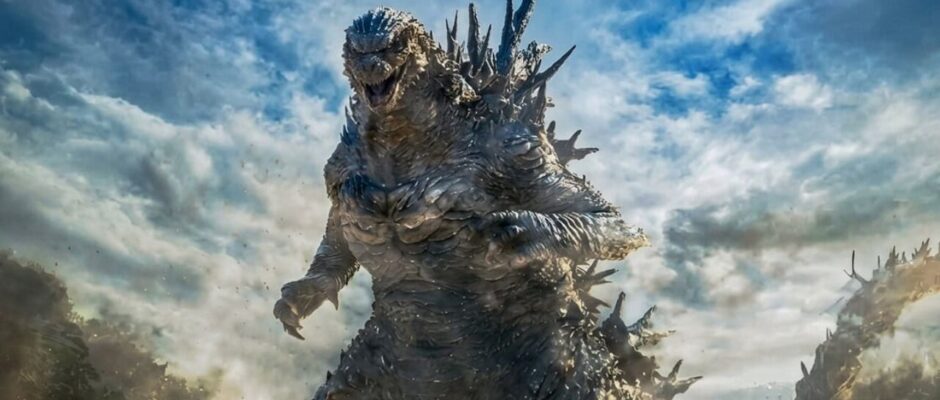
The most striking aspect of Godzilla Minus One’s (2023) back-to-basics approach to the classic kaiju is the quality of its VFX work. The famous atomic lizard has seen a resurgence since the American Godzilla reboot, directed by Gareth Edwards, in 2014, leading to Universal’s “Monsterverse” as well as a Japanese reboot in Hideaki Anno and Shinji Higuchi’s Shin Godzilla (2016), which featured a more grotesque, slithering, and constantly mutating reptilian take on the creature, in contrast to the more hulking monster of Edwards’s movie. Minus One stands apart from these two interpretations for its more classical approach to Godzilla’s design, and for the intimate detail and tactility of that rendition; its digital models convincingly approximate older visual-effects methods—like puppets, costumes, and miniatures—on a comparatively minuscule budget, estimated to fall between $10 and $15 million.
Such efficiency may be partly attributed to director Takashi Yamazaki’s experience as a VFX supervisor on a number of his films (as well as his directing credits on such features as Lupin III: The First, 2019, the first 3D-animated film in the long-running anime franchise). Yamazaki was approached by Toho to make Godzilla Minus One, which became the most successful Japanese Godzilla film of all time, earning him and his team the first Oscar for Best Visual Effects awarded to a non-English-language film. Now, Yamazaki returns with a sequel, Godzilla Minus Zero (2026), which reportedly gave him a substantially larger budget to work with. That expanded scope is clear in the visual acuity of its depiction of Godzilla’s age-old foe, King Ghidorah, and audacious sequences of monster-on-monster violence on a scale that exceeds even the apocalyptic terror of the previous film. Ahead of the film’s release, I spoke to Yamazaki about the building blocks of Minus Zero.

KAMBOLE CAMPBELL: King Ghidorah is a character with a long onscreen history. Which key elements were you thinking about when refining its look?
TAKASHI YAMAZAKI: The basic Ghidorah design has been [well established] over the last few decades. But I did try to add a little bit of my own interpretation to it, skewing the design of Ghidorah a little more in this sort of Western, dragon-like direction. Having the hands on the tip of the wings, it’s almost like a bat’s wing. Even that membrane in between the skeletal structure of the wings is very bat-like. King Ghidorah also has three heads, which is a key element of the kaiju’s design. But when it’s flying, I wanted it to feel very divine or godlike by nature. There’s a creature called Hōō; it’s like an Asian style of phoenix, and it traditionally has had very long tails, with its own membrane-like thing in between the tails. I drew a lot of inspiration from that, too.
KC: I was impressed not just by the shape of the creatures but the texture of their skin. How do you approach these textures? How do you make them feel believable?
TY: There’s a team member on our VFX staff who designed the previous Godzilla and also designed this one, and he pays a lot of attention to detail. He was studying wild animals, alligators, these giant fish in the Amazon. We drew a lot of inspiration from nature itself. And he’s also an excellent, excellent sculptor. If I just leave it to him, generally he’ll come up with some really good design. But we did have a pretty extended discussion about the color. King Ghidorah is known for its gold tint, but we also wanted to ground the design a little bit. So we asked, How far do we skew to more natural colors, and how much gold do we include? Ultimately, we wanted it to feel like gold, but in a way that could exist in nature.

KC: I’m assuming that you had more resources for this film than you did with the previous film. In terms of the VFX, what were you able to accomplish on Godzilla Minus Zero that you couldn’t with the previous film?
TY: We did get an increase in budget, maybe 30 percent more than the previous film. That was nice, but there were still a lot of challenges we had to overcome and solve. One of the areas of VFX that we really pushed this time around was the expression of the sky—making a sky that feels real is actually harder than you think—and being able to control the different camera angles from the sky. Once you’re starting to manipulate the camera and you tilt the camera down, you’re going to see a lot of what’s on the surface of the Earth. So we flew drones and took a lot of reference footage, especially in the countryside. And one thing we saw was the rice fields. Modern rice fields are very grid-like, but in the 1940s [when the film is set], the rice fields would be more aligned with the geography in which they were planted. They’d have very quirky, weird shapes, weird borders. So recreating that was a pretty big undertaking—in a way that extends all the way to the horizon, while also managing the sky. I think it came out quite nicely. But the camerawork was the area where we pushed our VFX chops this time, making sure the visual expression of the Earth also aligns with the horizon and the clouds and many other things.
KC: Godzilla Minus One revisited Godzilla as a metaphor for nuclear weapons. How did you want to expand on this theme in the new film?
TY: Godzilla has been a symbol for nuclear power and war, a general image of terror. That’s something that we didn’t change between Godzilla Minus One and Godzilla Minus Zero. Over the years, Godzilla has proven that it’s a very flexible IP: it could take on a lot of things people threw at it. It could go all the way from funny to very serious. But our interpretation for the Minus series is [indebted to] the original 1954 Godzilla. It certainly embodies a similar image. In Godzilla Minus Zero, perhaps we put a little more weight on the symbol of war, rather than simply the nuclear angle.

KC: Often, the VFX work in both films feels reminiscent of miniatures and rubber suits, a suitable homage to the original films. How do you find a good halfway point between an homage to the past and more modern, realistic detail?
TY: With the original Godzilla, they shot everything with practical effects; they had to, and I grew up on that. So there’s certainly homage paid to that rubber-suit type of kaiju movement and motion, and in Godzilla Minus One, I paid very close attention to that. We actually restricted Godzilla’s range of motion in a similar way to what a suit actor would have been able to do. But with Godzilla Minus Zero, we basically took off that limit because we knew Godzilla was going to fight King Ghidorah, and it would need more range of motion to be able to fully express that. The scene where Godzilla and King Ghidorah interlock with each other definitely requires more range of motion than what an actor in a suit would have been able to do. That was probably the main evolution between Godzilla Minus One and Godzilla Minus Zero.
In terms of the miniature-type feeling that you describe, there are probably more miniatures used in this movie than you think, especially the scenes with a lot of ruins in the town. We would build a set, and the first or second layer of the set would be actual-size ruins, because we would have human actors interacting in front of it. But the layer behind that is miniatures, and then as you go even farther back [toward] the horizon, it all becomes CG.
KC: You’ve been a VFX artist in the past and served as a VFX supervisor on many of your films. How did this benefit your perspective as a director on Godzilla Minus Zero?
TY: I think my VFX background really increases the cost-performance ratio in terms of developing looks and knowing how and where to shoot. For example, when I’m writing the screenplay, in my mind, I can already see [how] I want to do this scene or make a camera composition. I’m already thinking, I could do this area in VFX, or, We’ll build the set only up to a certain point; I don’t need the rest of the set, because I know we can do it in VFX. This optimizes the ideation all the way to the final execution, and it allows for very quick decisions and feedback. There’s not a lot of waste in terms of going from screenplay to final visual. I’ve also seen the evolution of VFX from miniatures and stop-motion trickery all the way through CG. I’ve trialed and errored different effects in every generation, so there are moments where I can revert back to older techniques. If you were born into the CG era, using miniatures might not even be on your radar; it’s not a technique you would think about. But combining CG with miniatures, and with practical effects—that through line is something I’m uniquely positioned to use to make better, quicker decisions about where to put more money and effort. Because I know how much budget we have to deploy and where we can fill in the gaps with VFX, I know how to maximize what we can put on the screen.
Publisher: Source link