
Back to selection
Considerations
Covering the annual film industry awards races, with sharp commentary on the pictures, the players, the money, and the spectacle. by Tyler Coates
Into the Woods
 Wildwood (2026)
Cinematographer Caleb Deschanel is a six-time Oscar nominee, having earned nods for The Right Stuff (1983), The Natural (1984), Fly Away Home (1996), The Patriot (2000), The Passion of the Christ (2003), and Never Look Away (2018). A 1968 graduate of the University of Southern California School of Cinematic Arts—where he and fellow classmates George Lucas, John Milius, Howard Kazanjian, and Walter Murch were members of the group known alternately as the USC Mafia and The Dirty Dozen—Deschanel first worked in the camera department under cinematographers like Gordon Willis (on The Godfather, 1972), Mitch Breit and Al Ruban (on A Woman Under the Influence, 1974) and Vittorio Storaro (on Apocalypse Now, 1979).
At the age of 82, with dozens of feature films on his resume, Deschanel ventured far from his comfort zone on his most recent project. Laika’s epic fantasy Wildwood—an Oscar frontrunner for Best Animated Feature—finds Deschanel working for the first time in the medium of stop-motion animation. A seventh Best Cinematography nomination for Deschanel this year would be historic: no stop-motion film has ever been acknowledged in that category.
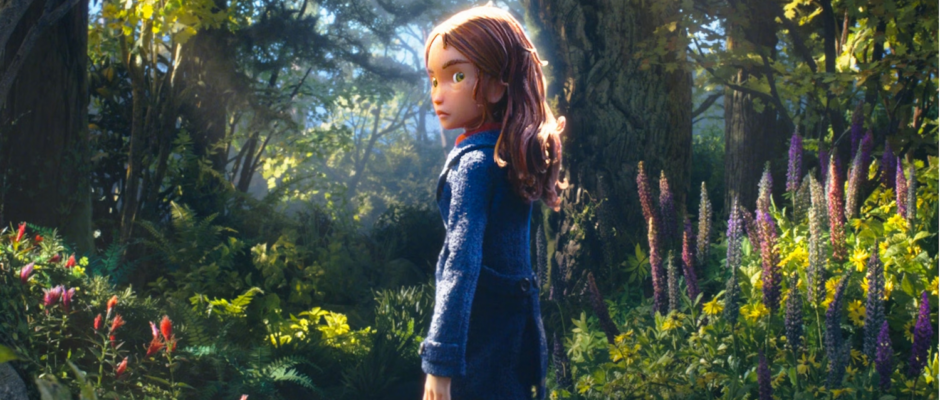
Based on the novel by Decemberists frontman Colin Meloy, adapted by Chris Butler, and directed by Travis Knight, Wildwood follows Portland teen Prue as she is thrust into a nightmare when her toddler brother Mac is abducted by a murder of crows and carried off into the Oregon wilderness. Accompanied by her anxious schoolmate Curtis, Prue enters the eponymous kingdom and discovers a magical world in which humans and anthropomorphized animals live together—but not necessarily harmoniously.

Deep in the forest, the sorceress and former governess Alexandra plans her revenge on the community that forced her into exile. In an underground lair, she employs dark magic in attempts to reunite with her late son, Alexi, who went missing in the woods and was left for dead as a young boy. Central to her scheme is Mac, whom she plans to sacrifice in order to awaken the ivy that has consumed most of the forest and will no doubt destroy civilization in Wildwood.
“It’s such a mythological story, and they’re really fascinating characters,” says Deschanel of what drew him to Wildwood’s dual themes of coming of age and living through grief. And the large scale of the project was impossible to ignore: “It’s one of these great epic stories—The Odyssey of stop-motion movies.” It’s an apt comparison; with a runtime of 132 minutes, Wildwood is the longest stop-motion film ever made. And its voice cast is also star-studded: Peyton Elizabeth Lee and Jacob Tremblay star as Prue and Curtis, respectively, while the ensemble includes Carey Mulligan, Mahershala Ali, Richard E. Grant, Tom Waits, Charlie Day, Amandla Stenberg, Tantoo Cardinal, Rob Delaney, and Angela Bassett.
“I was fascinated by the idea of how big it was,” Deschanel continues. Sealing the deal was his meeting with director Travis Knight, who is also Laika’s president and CEO and served as the lead animator on the studio’s Coraline (2009), ParaNorman (2012), and The Boxtrolls (2014) before making his directorial debut with the company’s Kubo and the Two Strings (2016). “I could sense that he was really, really dedicated to this and taken by the themes of the movie, and he was very convincing without revealing to me how complex it would be,” says Deschanel. “I was seduced by both the story and the idea of making a stop-motion film.”

Knight’s dedication to the film was rooted in its Portland setting, where the director grew up and where Laika is based. Deschanel says the real-life Portland, where he spent two years during the course of production, was a major influence on the way he wanted to capture both the city and the terrain of the Pacific Northwest that served as inspiration for the Impassable Wilderness that contains Wildwood and its residents.
With one of the ParaNorman puppets, whose size matched the Prue and Curtis puppets, Deschanel ventured into the woods surrounding Portland. “I took him around and put him in different parts of the woods in sunlight and in shade, and some days in fog and rain, and spent a lot of time photographing him,” Deschanel says. “Every movie you do has its own reality, particularly mythological stories like this. It [allowed me to] acclimate myself to the idea of shooting the movie. And I’m sure there were all these people walking by on the trails, staring at this crazy guy photographing a puppet in the middle of the forest.”

Getting comfortable—and maintaining his patience—was key to Deschanel’s job, and he admits he was at first overwhelmed by the magnitude of the production. For starters, there’s the simple, yet dilatory, process of stop-motion animation: a series of still photographs that animators assemble into a film. “On a live-action movie, you have actors perform [a scene] and they bring something you didn’t expect, something new and wonderful that alters your opinion of where the scene is going,” he says. “On Wildwood, we did one shot at a time, and it took a long time to really put it together in your head.” Also discombobulating was working with different versions of the puppets and locations at various scales. He notes that the Awkwafina-voiced Septima, a rat that is naturally smaller than the human characters, required that larger versions of its scene partners be built so that the puppeteers could properly manipulate the rodent puppet.
But the experience of shooting a stop-motion film also recalled the pre-digital filmmaking era. “In the old days, on film, you’d see an actor’s performance and you’d judge it on the day,” says Deschanel. “You would say it’s incredible, or maybe you wouldn’t quite get it. But when you see it on screen, it often has a different impression on you.” But here, there were no actors, and the dailies were rough enough that “the costumers, the set people with the props, and me and the cameramen would all sit down and [ask], is this correct?” Everyone had to trust the process—that the animators would assemble the best possible product.
“Almost every time, it was a real revelation to see how much character and how much emotion [the animators] could build into these characters,” says Deschanel. “One of the joys of doing the film was seeing the scenes after they locked themselves up for a week or two, whatever it takes. That was really a joy, because there are so many talented animators who worked on the film.”
Publisher: Source link