

Back to selection
Matthew Rankin on the Enchanting Specificity of Ladies and Gentlemen, Brian Mulroney
 Ladies and Gentlemen, Brian Mulroney (2026)
One cold February day in Ottawa in 1976, the Progressive Conservative Party of Canada held its seventh leadership convention, its first in nearly a decade. The PCs were at a crossroads. With former Prime Minister John Diefenbaker watching on, the party was set to choose a direction for the future after having lost the last five elections to Lester Pearson and Pierre Trudeau’s Liberal Party. Into the fray stepped Brian Mulroney, a lawyer and conservative political activist from Baie-Comeau, Quebec, bringing a new, showier, TV-ready, more American-style approach. He was roundly defeated, with many traditionalist Progressive Conservatives balking at his high-dollar campaign, considered anathema to the party’s working-class base. After a stint as the president of the Iron Ore Company of Canada, Mulroney returned to politics in 1983, defeating embarrassed leader Joe Clark to lead the PCs to victory at the peak of the Reagan and Thatcher era, with neoliberal ideas of his own to match.
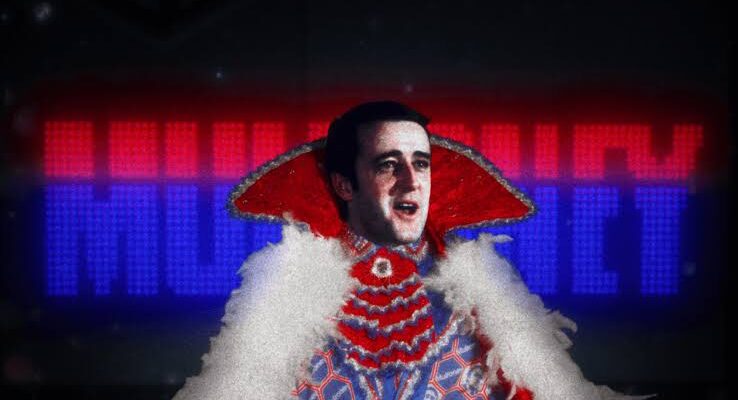
This is the story told in Ladies and Gentlemen, Brian Mulroney (2026), the new film from Universal Language (2024) director Matthew Rankin. It’s the latest in his suite of hyper-Canadian feature films, which also includes his 2019 debut, The Twentieth Century, a surreal, hilarious, and heavily fictionalized portrait of William Lyon Mackenzie King, another Canadian prime minister. Where that film played as a deranged, German Expressionist biopic of Mackenzie King, Ladies and Gentlemen, Brian Mulroney takes full advantage of Canada’s vast film and television archives to construct a historical documentary styled as a kaleidoscopic six-episode retro TV broadcast. With hilarious graphics and audio interventions, a pulsing electronic score, and incredible archival footage, Rankin reconstructs the story of Mulroney’s rise to power as an endlessly compelling farce. Mulroney’s big speech at the convention is depicted as a fantastical Liberace-like Vegas performance, like something out of a drugged-out fever dream. The menacing, floating head of Trudeau haunting the Liberal Party had me in stitches every time it appeared.
Ladies and Gentlemen, Brian Mulroney, which won the 2026 Midnight Madness People’s Choice Award at the Toronto International Film Festival, where it had its raucous world premiere, is the latest in a recent wave of Canadian films making novel use of their country’s cultural and historic specificities. Nirvanna the Band the Show the Movie (2025), Blue Heron (2025), Red Rooms (2023), and fellow 2026 TIFF prizewinners Sunburn and Smudge the Blades have proven the secret to securing both hometown pride and international recognition is the crafting of “very precise worlds,” to steal a phrase from Rankin.
While floating around the festival, I kept hearing from Americans who’d fallen head-over-heels for Ladies and Gentlemen, Brian Mulroney, a film about extreme Canadian political arcana, even the broad details of which are unknown to many Canadians. They were fascinated by great names like Diefenbaker and Pilkington, by great characters like the loveable sad sack Joe Clark and the talking pineapple Ananas, and by the contradiction in terms represented by the Progressive Conservatives (I promise you, we barely understand it ourselves). These cultural oddities seemed to pull people in enough to appreciate the film’s story about a rising tide of neoliberalism and a new, more crass, more corporate style of politics, a phenomenon that gave rise to our present circumstances.
I got together with Matthew Rankin during TIFF at the offices of the National Film Board of Canada, which produced the film, to talk all about Ladies and Gentlemen, Brian Mulroney, the wild world of Canadian politics, the importance of national archives, the value of hyperlocalism in cinema, and his ideas for a sequel.

COREY ATAD: You drop the audience right into the 1976 Progressive Conservative convention without much context. I was curious about the decision to approach it that way, because even a lot of Canadians who watch it won’t know any of this history.
MATTHEW RANKIN: That’s true. That’s what I like about watching a film, suddenly being dropped as if from a helicopter into a zone where I don’t necessarily speak the language. I don’t know the customs, and I have to sort of observe patterns and learn. I think that’s actually the greatest pleasure of watching a film.
I watched Succession not so long ago, and I don’t understand 50% of that show. It’s the world of high finance. This is abstract to me. But it doesn’t really matter. There’s a way in for you. You observe patterns, and you observe these characters and their problems, how they’re dealing with them and how they present, and there’s something enchanting about that. And I think that this film is a little bit like this, too. That’s the gamble of it, and I think that’s as old as time. Have you been to Brooklyn before?
CA: I have not. I’ve been to New York several times, but not to Brooklyn somehow.
MR: But you know something about Brooklyn.
CA: I know a lot because I’ve seen movies and TV shows.
MR: Precisely. And in Canada, we’re somehow bashful about not explaining things.
CA: In the last few years there’s been a wave of good Canadian films. Quebec always has produced good films, but there seems to be more good work coming out of Anglo Canada, in particular, and a lot of it either proudly Canadian or proudly local.
MR: Maybe not proudly. Maybe critically. But yes.
CA: Let’s put it this way: unselfconsciously Canadian.
MR: Yes.
CA: Which feels very unusual for a Canadian, speaking as a Canadian. We’re always apologizing for our own existence. And it’s interesting to see movies like this one, or movies like Nirvanna the Band the Show the Movie or Blue Heron.
MR: Exactly, and you have figure them out. They’re not going to spoonfeed it to you.

CA: And you’re trying to be unselfconsciously Canadian in your work, too?
MR: Yeah, well, this is what I know. I’m following what is thrilling to me.
CA: So, like conservative party conventions.
MR: Yes, as improbable as that is, it’s utterly thrilling to me. I mean, a lot of that comes from— Well, it comes from all manner of things. One is the weird reckoning we’re currently having with conservatism at large, and of course, what this film deals with is progressive conservatism. This was the final blast from that cannon. It all changes with Mulroney, and you see the seeds of its own destruction in this movie.
I read a great progressive conservative philosopher, George Grant. On many levels, George Grant’s work has not necessarily aged tremendously well, but there are some questions he raises which I think are still very pertinent, particularly as we stare down the—how shall I call it?—the homicidal eugenics of Donald Trump. He asked this question in 1963: “Why?” Why does this exist? Why does Canada exist? Why should it exist? Should it? And if it should, then doesn’t that imply that it’s good that it exists? And if it is good that it exists, why? What’s good about it? What is the value of this statehood?
There might be readings that there is no value to it at all. There might be readings that it’s irrelevant, that all that matters is the economy. My personal feeling—and I say this as a lifelong social democrat—is that I think of institutions as expressions of solidarity. We live in a country with all manner of people, most of whom we don’t know, and many of whom we might not agree with or even like that much. But fundamentally we care about them, because we’re all part of this ecosystem. And if that person I don’t know is sick, I’d rather that they have the help they need. This is just basic human solidarity. And that has collapsed, I think, broadly speaking. We’re now living in this more pathological age where it’s every man for himself, and it’s like, I don’t care about your need for unemployment insurance and chemotherapy and a National Film Board of Canada. I don’t use any of that, so I’m not going to pay for it. That’s your problem.
And that’s bad. That makes me think that this [institution of statehood] actually doesn’t exist, in fact, and there’s no reason for it. So now we’re in this weird zone where we’re asked that question very directly. So how do we answer it? I think certainly art and culture are places where we can look for answers.

CA: You have these characters in the film. Real people, but you treat them really like characters. My favorite, of course, is Joe Clark.
MR: Yes, he comes off rather well.
CA: He does! Even Mulroney himself—by the end of it, you’re almost won over by him. It is a very flattering portrait, in a way, despite the criticism that’s layered in there. How did you view that battle between those two characters, with Joe Clark representing this older guard that didn’t have the charisma or sense of the popular feeling, but maybe had a sounder vision of how society should be?
MR: I come from Winnipeg, so I like underdogs, and Joe Clark is definitely an underdog. And that I find to be sincerely very charming. I actually think Joe Clark is very Canadian, in all the most clichéd ways we might imagine Canada. He’s very courteous and a little bit awkward, doesn’t speak French that well, but tries, and all these sorts of things. He just wants everybody to get along. He’s kind of sweet. And he’s not a raging ideologue.
But Joe didn’t really have much of a chance sitting next to Brian. It’s really interesting to watch this press conference that Brian held to assure everyone that he supported Joe. You see these two men sitting together, and Brian is so much more powerful in every place that Joe is weak, and so much more convincing and so much more smooth. And even as he’s saying, “Oh, I’ve always supported Joe Clark,” he’s aware that everyone watching this is like, “Oh, well, that’s the guy who can do it.” So it’s a strange sort of dance that they’re having.
The Progressive Conservative Party under Joe Clark was all manner of things. It was a strange coalition. You had right-wing zealots who were obsessed with capital punishment and believed the metric system was making people into Soviets, and that the fluoridization of water was going to turn people into bilingual socialists and so forth. There’s this whole reactionary end of the party, but then on the other end of it, you had feminists, you had environmentalists, and Joe’s struggle was to somehow reconcile this bizarre coalition into a space of compromise. And he became engulfed by the right-wing of that party. Brian was able to tame them for a while, but then ultimately he became engulfed.
CA: Would you do a sequel covering that period?
MR: Yeah, I would love to. The original pitch of this was a multi-film epic. Because I feel like Mulroney in power really demands another film, maybe even two films. It’s an enormous, enormously complex story. Just the saga of this man’s life is completely overwhelming. The number of twists in this guy. His energy is spectacular.

CA: The film is playing with a kind of documentary reality, using real archival footage, but then twisting it, animating and adding little fictionalizations. Do you worry about confusing people’s sense of the facts?
MR: No, because I make it very blatant. I like to lean into artifice. I think the arc of film history has always been to erase artifice. It’s the idea that the purpose of making a film is verisimilitude, the simulacrum, and you want that to be so credible that you forget you’re watching a film. Our relationship with the simulacrum has transformed over time, right? At the beginning of cinema, you have a train headed towards the camera, and everyone [runs out of] the theater. They think they’re going to get run over. The simulacrum was that irresistible. Now we see explosions and aliens, and we’re so bored we fall asleep. My feeling is that the simulacrum may be ending. Verisimilitude is less and less interesting to me as a filmmaker. I feel like that’s where AI is going to, unfortunately, pass its hand.
I think that defiance of simulacrum, defiance of verisimilitude—even in the service of factual content—opens up new doors for image-making now. Much like when photography was invented, painting changed, right? It was all focused on verisimilitude.
CA: Right, and then it becomes abstract. We get cubism and all that.
MR: Exactly. So I feel like that’s kind of our moment as filmmakers. Just this morning, I did this TV interview. It was a conversation, and then they wanted to redo the intro like four times. We had to pretend to meet each other four times. It was so crazy, but that absolutely passes every test of journalistic standards. That’s completely normal, that in factual content you can have these little fictions, this mise-en-scène. But, of course, when you watch the final product, you will never doubt what you’re seeing.
CA: Hey, I’m going to be cleaning up this interview.
MR: Yeah, exactly. That’s right. This is what we do all the time. We organize the chaos of the world into some sort of coherent structure that has a flow. I’m interested in making these intrusions very blatant. I include these moments where you see Mulroney gearing up for a shot, clapping, and you see him performing. It’s like he goes into character.

CA: The first time we’re really introduced to Brian Mulroney in the film, it’s during this highly surreal, mostly animated sequence where he arrives onstage to give his big convention speech in 1976. It’s presented in the film as this soaring, booming speech. And then the next thing that happens is everybody at the convention going, “Oh, I didn’t like that.” Did you also play with the audio at all to make Mulroney’s speech sound bigger than it was?
MR: I guess we played with it a little bit, but I’m not sure it’s really the sound. I mean, obviously that didn’t happen, right? He did not levitate in the air. There were not Vegas showgirls.
CA: He didn’t arrive in this futuristic car.
MR: That’s right. He’s not dressed as Liberace. I think anyone watching this film will understand that this is an artistic intrusion, but it is in the service of a factual argument. The whole accusation that was thrown at Mulroney in the campaign was that he had too much money. He was too sleek. He was too garish. He was too showy, and he was trying to buy himself the leadership. And so the question was how to make that visually manifest. Because it’s not innately visual in and of itself.
CA: How about the archival footage? You include footage from a pretty astonishing number of sources. How much of it was from the NFB?
MR: A lot of it. I don’t know the exact percentage. The archival producer could tell you that, but it is a lot. I went through whole vaults of footage. There was a lot of stuff at Library and Archives Canada we had to digitize. There’s gold in that archive, but no one knows where it is. You have to really hunt. It’s just terrifyingly underfunded, but it holds the entire memory of the country. It’s incredible.
I have a background in academic history. I was on a path to becoming a historian in a previous life. I decided at a certain point I was not a scientist. My interest was an artistic one. But I was interested, even when I was thinking about being a scientist, in images. Historians are overwhelmingly obsessed with written words, written documents. And of course, the second half of the 20th century is the first time in history that things were recorded in image and in sound. When Thomas Edison invented the phonograph, people flipped out. They flipped out! The idea that you could listen to your dead relative singing after they were dead? Imagine. All of human memory exists without that until the late 19th century.
CA: Now there’s almost too much of everything recorded, and most of it’s going to be lost too.
MR: And because of the simulacrum, we can’t even differentiate the real world from the fake one. But I’ve always been really interested in preserving this stuff. Some of which is extremely ephemeral and doesn’t necessarily have any obvious value. What is the value of a station identification, or for example? There’s this part in the film where Joe is giving a speech, and you only see it for a few frames. The image got all wonked, and it says, “Technical problems are temporary.” That was a real thing. I didn’t add that. But what is the value of preserving that? It’s like a para-televisual artifact almost. It isn’t something that was created. No one thought about it. It’s not a document of anything, other than a glitch.
CA: No, but it’s an experience of life, right?
MR: Exactly. That’s right. So all of this stuff I feel has enormous value. Like the Ontario Ministry of Health “drunk dad” commercial, which we do cite in the movie. That still exerts great mnemonic power over the Ontario memory, but you wouldn’t necessarily think of it as a historically notable artifact. This project is, to a very large extent, an effort to defend that material. There’s all this stuff that is locked in a vault at the National Film Board, and it’s incredible, and it presents decades of collective memory. A project like this allows it to exist and to live and to be part of people’s lives in a way that it can’t if it’s just in a storage container.

CA: I’ve spoken to Americans who really love the film. It’s interesting that you can present it in this form, and people who have no concept of Canadian politics, who maybe don’t even understand how the parliamentary system works in great detail, can watch it and still connect. Obviously, you’re making art for everybody, but how much of it to you is specifically for Canadians, versus something more universal?
MR: I think there are different paths in. It just takes a basic curiosity. The whole conservative angle is a way in. The characters are infinitely enchanting. It is also funny. But like anything, I think the pleasure of watching a film is just being in a very precise world.
CA: What do you mean by precise?
MR: I mean a precisely defined world. Like, for example, let’s take the opposite of what we’re describing here: a Canadian film that makes the Canadianness of it all as general as possible, and spreads it out in such a way that you don’t recognize any specificity to it. I feel like those are the films that really collapse.
CA: That feels like it was a lot of Canadian cinema for a long time.
MR: Exactly. Yeah, that’s right.
CA: Not everything, of course.
MR: But a lot of stuff. It’s true. There’s a sort of watering down where it’s like, “Well, people won’t entirely understand that, so we should just water it down.” I’ve lived in Quebec for a long time now, and I feel like the reason Quebec has become one of the great cinematic cultures of the world has a lot to do with the fact that it leans right into its specificity. In Mommy [2014], the most celebrated film of Xavier Dolan, the French that is spoken is extremely strange. Like, they subtitle it in France. He leans straight into it, and it becomes utterly fascinating because it’s very precise.
I met the editor who works with Lars von Trier one time, Molly Malene Stensgaard. She edited, among other things, [eight episodes of] The Kingdom (1994–97). And as you may recall, in The Kingdom, there’s this Swedish character who hates Denmark. He has this vow of eternal scorn for the Danish race, and it’s very funny. You learn about this bizarre, fratricidal contempt that exists between Sweden and Denmark, which I didn’t know about before I watched that show.
CA: But of course, many countries have these kinds of relationships.
MR: Exactly. So he made that show first and foremost for Denmark, for Danes. And then there was some talk about translating it into Italian and showing it in Italy, and Lars Von Trier, the first first thing he said was, “We’ll have to cut out the whole Danish–Swedish thing because people won’t understand that. It doesn’t make any sense outside of us.” But Stensgaard said, “No, no, no, no! Try it. Let’s do a test screening, and we’ll see.” They did a test screening in Italy, and people were on the floor screaming. They thought it was so funny. Because of course, we can relate to it. There might be certain codes we don’t grasp, or certain references we might not entirely share, but we get it, and it’s very funny.
The fact of something being funny is very enchanting. Often Canada has sought to avoid its specificity in filmmaking, but the more precise that a world becomes, the more enchanting it is as a cinematic experience.
Publisher: Source link